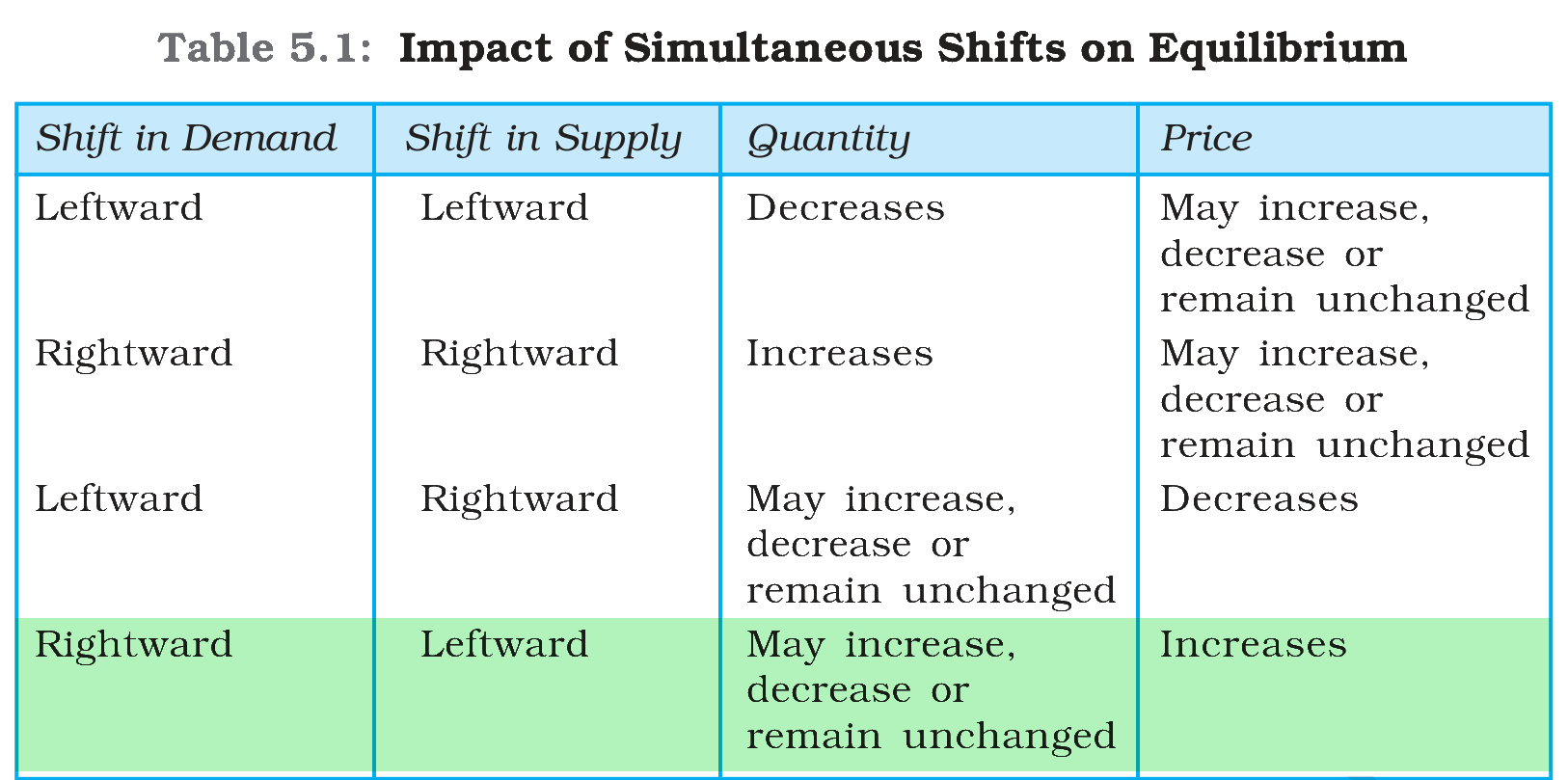
If the number of sellers in the market decreases and the consumers’ income increases (normal good), then what can we say with certainty?
Answer & explanation
Correct answer: option 2
The correct answer is Option (2) → Increase in equilibrium price
Fewer sellers shift the supply curve to the left. Higher income shifts the demand for a normal good to the right.
Both changes create excess demand at the old price, so the price rises for certain. The quantity is pulled down by the supply shift and up by the demand shift, so it may rise, fall or stay the same.
NCERT (2026-27): “Demand Shift … Suppose due to a hike in the salaries of the consumers, their incomes increase. … With an increase in income, consumers are able to spend more money on some goods. But recall from Chapter 2 that the consumers will spend less on an inferior good with increase in income whereas for a normal good, with prices of all commodities and tastes and preferences of the consumers held constant, we would expect the demand for the good to increase at each price as a result of which the market demand curve will shift rightward. Here we consider the example of a normal good like clothes, the demand for which increases with increase in income of consumers, thereby causing a rightward shift in the demand curve.” “Supply Shift … Now, suppose due to some reason, the market supply curve shifts leftward to SS2 with the demand curve remaining unchanged, as shown in panel (a). Because of the shift, at the prevailing price, p0, there will be excess demand equal to q0'' qo in the market. Some consumers who are unable to obtain the good will be willing to pay higher prices and the market price tends to increase. The new equilibrium is attained at point G where the supply curve SS2 intersects the demand curve DD0 such that q2 quantity will be bought and sold at price p2. …” “Simultaneous Shifts of Demand and Supply … In the first two cases which are shown in the first two rows of the table, the impact on equilibrium quantity is unambiguous but the equilibrium price may change, if at all, in either direction depending on the magnitudes of shifts. In the next two cases, shown in the last two rows of the table, the effect on price is unambiguous whereas effect on quantity depends on the magnitude of shifts in the two curves.”
|