Which of the following is NOT a source to reconstruct the history of the Maurya Empire?
Answer & explanation
Correct answer: option 4
The correct answer is Option (4) → Harshacharita
Option (1) Sculpture — A source (Incorrect). Archaeological finds, especially sculpture, are used to reconstruct the history of the Mauryan Empire.
Option (2) The account of Megasthenes — A source (Incorrect). Megasthenes was a Greek ambassador to the court of Chandragupta Maurya; his account survives in fragments and is a valuable contemporary work.
Option (3) Arthashastra — A source (Incorrect). Parts of the Arthashastra were probably composed by Kautilya or Chanakya, traditionally believed to be the minister of Chandragupta; it is another source often used.
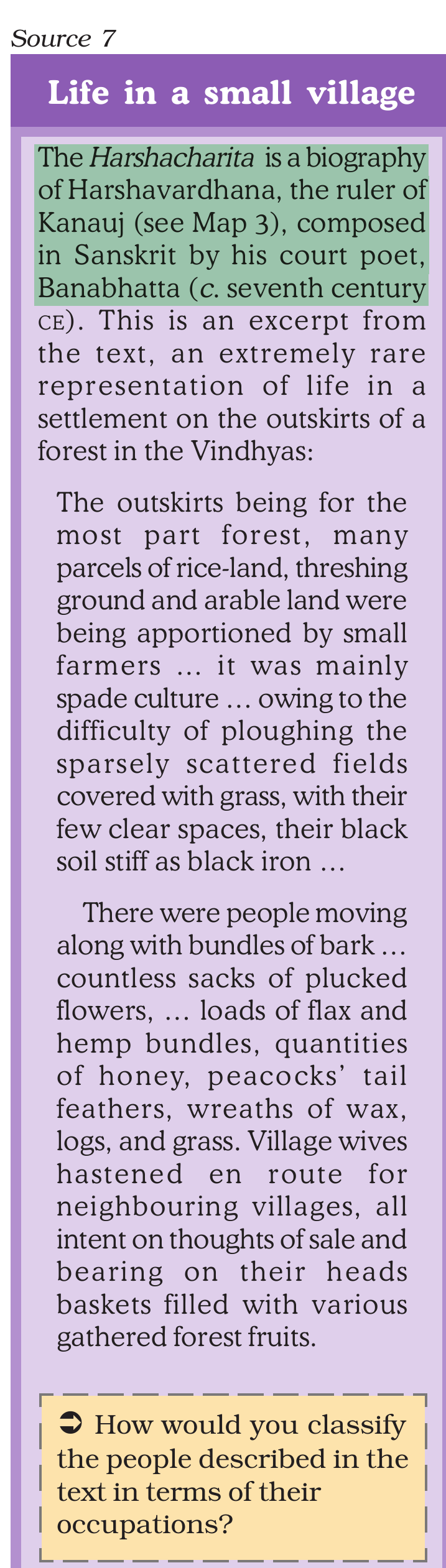
Option (4) Harshacharita — Not a source (Correct). The Harshacharita is a biography of Harshavardhana, the ruler of Kanauj, composed in Sanskrit by his court poet Banabhatta in about the seventh century CE, long after the Mauryas.
NCERT (2026-27): “3.1 Finding out about the Mauryas … Historians have used a variety of sources to reconstruct the history of the Mauryan Empire. These include archaeological finds, especially sculpture. Also valuable are contemporary works, such as the account of Megasthenes (a Greek ambassador to the court of Chandragupta Maurya), which survives in fragments. Another source that is often used is the Arthashastra, parts of which were probably composed by Kautilya or Chanakya, traditionally believed to be the minister of Chandragupta. Besides, the Mauryas are mentioned in later Buddhist, Jaina and Puranic literature, as well as in Sanskrit literary works. While these are useful, the inscriptions of Asoka (c. 272/268-231 BCE ) on rocks and pillars are often regarded as amongst the most valuable sources.…”
|