
The figure shows two aggregate demand lines: AD = C̄ + cY + I + G and AD′ = C̄ + c(1 − t)Y + I + G, where t is a proportional tax rate.
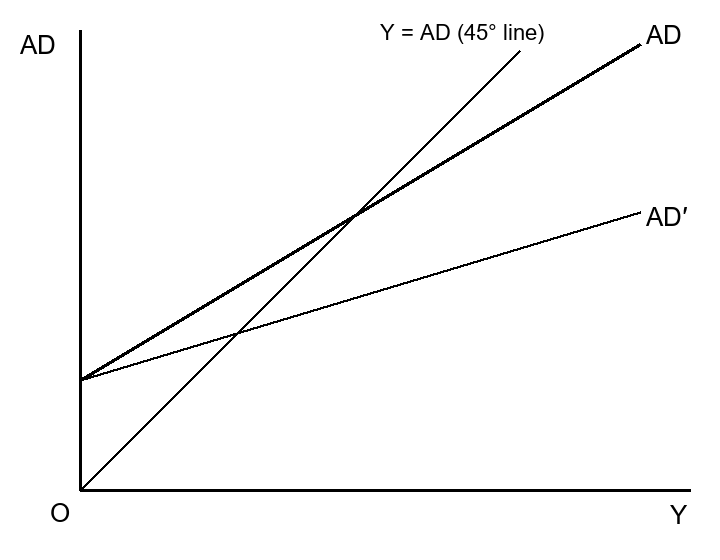
Why is AD′ flatter than AD?
Answer & explanation
Correct answer: option 4
The correct answer is Option (4) → The marginal propensity to consume out of income falls to c(1 − t)
With a proportional tax, a part t of each extra rupee of income goes as tax. Households spend c of the rest, so consumption rises by only c(1 − t) per unit of income. The slope of AD falls, and AD′ is flatter.
Investment and government spending stay the same in both lines; only the slope term changes.
NCERT (2026-27): “Case of Proportional Taxes: … We note that proportional taxes not only lower consumption at each level of income but also lower the slope of the consumption function. The mpc out of income falls to c (1 – t). The new aggregate demand schedule, AD′, has a larger intercept but is flatter as shown in …” |