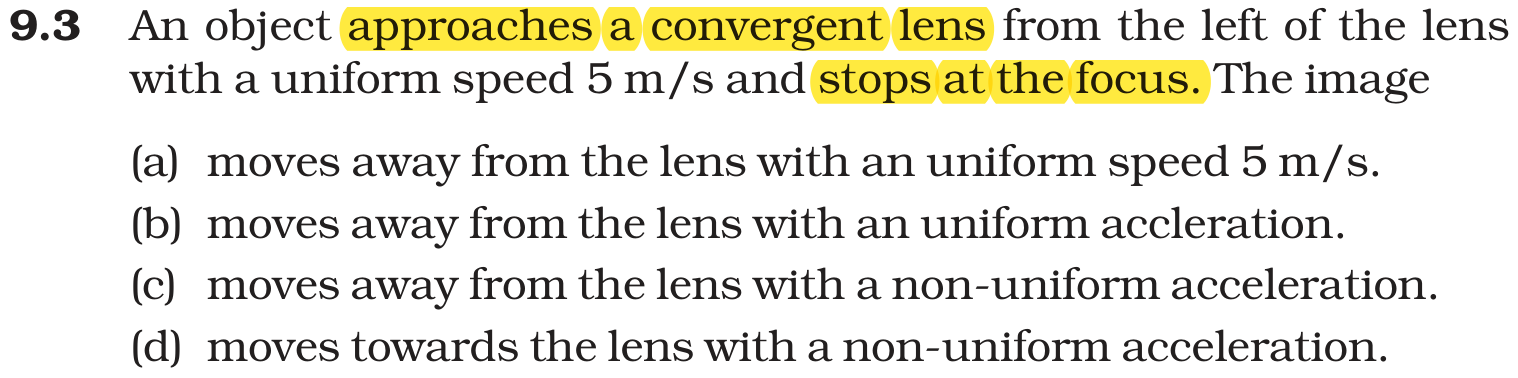
An object approaches a convex lens from distance with a uniform speed of 3 m/s and stops at the focus. The image
Answer & explanation
Correct answer: option 3
The correct answer is Option (3) → moves away from the lens with a non uniform acceleration
The positions of object and image are linked by the lens formula, so the speed of the image follows by differentiating it with time. Let the object distance be x (it decreases at 3 m/s) and the image distance y, both taken as positive numbers for a real image, with focal length f.
\( \displaystyle \frac{1}{x}+\frac{1}{y} = \frac{1}{f} \Rightarrow y = \frac{fx}{x-f} \)
\( \displaystyle \frac{dy}{dt} = -\frac{f^{2}}{(x-f)^{2}}\,\frac{dx}{dt} \)
The object approaches, so \( \frac{dx}{dt} = -3\,\mathrm{m\,s^{-1}} \), and the image speed is
\( \displaystyle \frac{dy}{dt} = +\frac{3f^{2}}{(x-f)^{2}}\,\mathrm{m\,s^{-1}} \)
This is positive, so the image moves away from the lens. It is not constant: as x decreases towards f, \( (x-f) \) shrinks and the speed grows without limit. Since \( x = x_0 - 3t \), the acceleration is
\( \displaystyle \frac{d^{2}y}{dt^{2}} = \frac{18f^{2}}{(x-f)^{3}} \)
which also changes with x. The image therefore moves away with a non-uniform acceleration, and Options (1) and (2) are ruled out.
Note: NTA picked this question from an NCERT Exemplar problem and changed the figures. Do not ignore the Exemplar while practising numericals.
NCERT Exemplar:
Ray Optics and Optical Instruments – …