
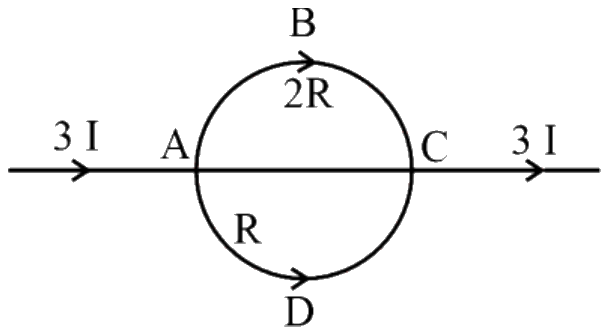
In the circuit shown below, a current 3I enters at A. The semicircular parts ABC and ADC have equal radii 'r' but resistances 2R and R respectively. The magnetic field at the center of the circular loop ABCD is ___________.
Fill in the blank with the correct answer from the options given below.
Answer & explanation
Correct answer: option 1
The correct answer is Option (1) → \( \displaystyle\frac{\mu_0 I}{4r} \) out of the plane
The two semicircles are in parallel between A and C, so the current 3I divides in the inverse ratio of their resistances.
\( \displaystyle I_{ABC} = 3I \times \frac{R}{2R + R} = I \qquad I_{ADC} = 3I \times \frac{2R}{2R + R} = 2I \)
A semicircular wire of radius \( r \) carrying current \( i \) gives a field \( \mu_0 i/4r \) at its centre (half that of a full loop). The straight leads lie along the line through the centre, so they give no field at the centre.
Arc ABC (current I, from A over the top to C): the current goes round the centre clockwise, so its field is into the plane.
\( \displaystyle B_{1} = \frac{\mu_0 I}{4r}\ \text{(into the plane)} \)
Arc ADC (current 2I, from A under the bottom to C): the current goes round the centre anticlockwise, so its field is out of the plane.
\( \displaystyle B_{2} = \frac{\mu_0\,2I}{4r}\ \text{(out of the plane)} \)
The two fields are opposite, so the net field is their difference, in the direction of the larger one.
\( \displaystyle B = B_{2} - B_{1} = \frac{\mu_0\,2I}{4r} - \frac{\mu_0 I}{4r} = \frac{\mu_0 I}{4r}\ \text{(out of the plane)} \)