Match List I with List II
| LIST I | LIST II |
| A. The range of sin−1x is | I. \(\left[\displaystyle\frac{-\pi}{2},\frac{\pi}{2}\right]-\{0\}\) |
| B. The range of tan−1x is | II. \(\left(-\displaystyle\frac{\pi}{2},\frac{\pi}{2}\right)\) |
| C. The range of cosec−1x is | III. \([0,\pi]-\left\{\displaystyle\frac{\pi}{2}\right\}\) |
| D. The range of sec−1x is | IV. \(\left[\displaystyle\frac{-\pi}{2},\frac{\pi}{2}\right]\) |
Choose the correct answer from the options given below:
Answer & explanation
Correct answer: option 4
The correct answer is Option (4) → A - IV, B - II, C - I, D - III
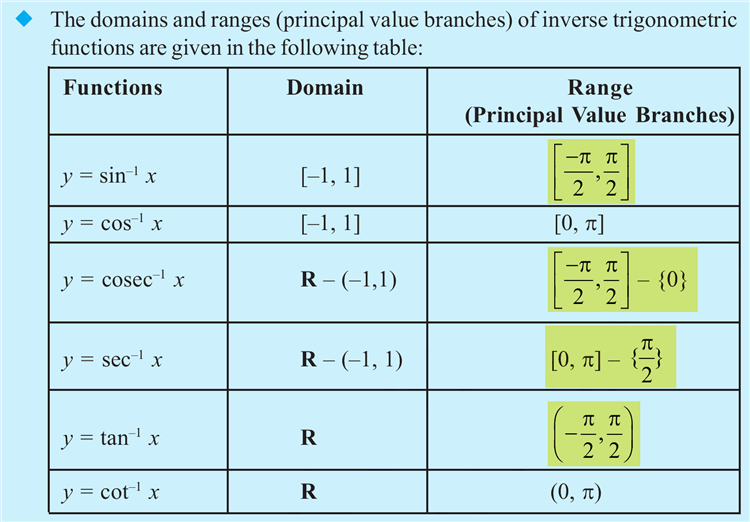
The ranges are the principal value branches of the inverse trigonometric functions.
(A) The range of sin−1x
This matches (IV) \(\left[-\frac{\pi}{2},\frac{\pi}{2}\right]\). sin takes every value in [−1, 1] once on this closed interval, the end points included.
(B) The range of tan−1x
This matches (II) \(\left(-\frac{\pi}{2},\frac{\pi}{2}\right)\). The end points are excluded because tan is not defined at \(\pm\frac{\pi}{2}\).
(C) The range of cosec−1x
This matches (I) \(\left[-\frac{\pi}{2},\frac{\pi}{2}\right]-\{0\}\). 0 is removed because cosec 0 is not defined.
(D) The range of sec−1x
This matches (III) \([0,\pi]-\left\{\frac{\pi}{2}\right\}\). \(\frac{\pi}{2}\) is removed because sec \(\frac{\pi}{2}\) is not defined.
So the matching is A - IV, B - II, C - I, D - III.
NCERT (2026-27 edition):
Inverse Trigonometric Functions