In Dissociative Amnesia the person experiences -
Answer & explanation
Correct answer: option 4
The correct answer is Option (4) → A loss of memory of selective events, people, places or objects
Option (1) A loss of memory of all past and future events — Incorrect. Amnesia is a loss of memory for what has already happened. Future events have not yet taken place, so there is nothing about them to forget.
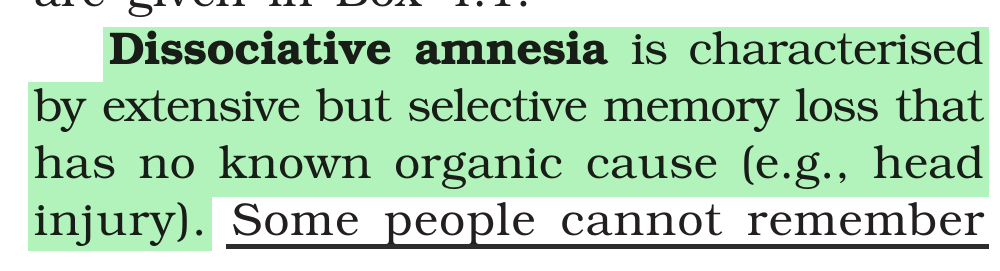
Option (2) A loss of memory of past events due to a head injury — Incorrect. Dissociative amnesia is a memory loss that has no known organic cause, and head injury is the standard example of such a cause. A memory loss produced by a head injury has a physical cause, so it is not dissociative.
Option (3) A loss of memory of all future events — Incorrect. Memory holds only what has been experienced; events still to come cannot be forgotten.
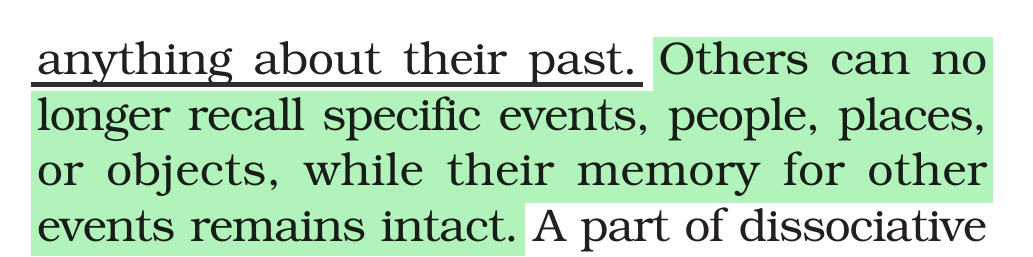
Option (4) A loss of memory of selective events, people, places or objects — Correct. Dissociative amnesia is characterised by extensive but selective memory loss that has no known organic cause. Some people can no longer recall specific events, people, places, or objects, while their memory for other events remains intact.
Note: The original NTA paper printed Option (2) as ‘A loss of memory of all past events’. NTA accepted both Option (2) and Option (4) as correct, because the book describes two forms of dissociative amnesia: some people cannot recall anything about their past, while others can no longer recall specific events, people, places or objects. Therefore, to leave a single correct answer, Option (2) has been changed to ‘A loss of memory of past events due to a head injury’, for the benefit of students.
NCERT: Psychology — Chapter 4: Psychological Disorders, Dissociative Disorders (2025-26)
|