
(Transportation problem) A brick manufacturer has two depots A and B, with stocks of 30000 and 20000 bricks respectively. He receives orders from three builders P, Q and R for 15000, 20000 and 15000 bricks respectively. The cost (in ₹) of transporting 1000 bricks to the builders from the depots are given below:
|
To → From ↓ |
Transportation cost per 1000 bricks (in ₹) |
||
|
P |
Q |
R |
|
|
A |
40 |
20 |
20 |
|
B |
20 |
60 |
40 |
The manufacturer wishes to find how to fulfil the order so that transportation cost is minimum. Formulate the L.P.P.
Answer & explanation
Correct answer: option 3
The correct answer is Option (3) → Minimize $Z = 40x - 20y$, Subject to: $x + y ≥ 15, x + y ≤ 30, x ≤ 15, y ≤ 20, x≥ 0, y ≥ 0$
To simplify, assume that 1 unit = 1000 bricks
Suppose that depot A supplies x units to P and units to Q, so that depot A supplies $(30 - x - y)$ units bricks to builder R.
Now as P requires a total of 15000 bricks, it requires $(15 - x)$ units from depot B. Similarly Q requires $(20 - y) $units from B and R requires $15 - (30 - x - y) = (x + y - 15)$ units from B. Using the transportation cost given in table, total transportation cost is
$Z_1 = 40x + 20y+ 20(30 - x - y) + 20(15 - x)+ 60(20 - y) + 40(x + y = 15)$
$=40x20y+ 1500$
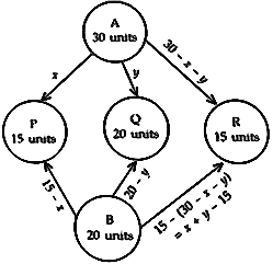
Obviously the constraints are that all quantities of bricks supplied from A and B to P, Q, R are non-negative,
i.e. $x ≥ 0, y ≥ 0, 30-x - y ≥ 0, 15- x ≥ 0, 20-y≥ 0, x + y - 15 ≥ 0$
Instead of minimizing $Z_1 = 40x - 20y+ 1500$, it is easier to minimize $Z = 40x - 20y$.
Hence the problem can be formulated as L.P.P. as
Minimize $Z = 40x - 20y$ subject to the constraints
$x + y ≥ 15, x + y ≤ 30, x ≤ 15, y ≤ 20, x≥ 0, y ≥ 0$.