
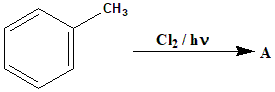
A in the above reaction is
Answer & explanation
Correct answer: option 1
The correct answer is Option (1) → benzyl chloride, C6H5CH2Cl
The conditions decide where chlorine enters toluene:
In light (hν) or at the boiling point, without a catalyst: \( \ce{Cl2} \) splits into chlorine atoms (free radicals), which take a hydrogen from the side chain. The benzyl radical formed is stabilised by resonance with the ring, so substitution takes place in the \( \ce{CH3} \) group.
In the dark with a Lewis acid (FeCl3): \( \ce{Cl^{+}} \) attacks the ring (electrophilic substitution), giving o- and p-chlorotoluene.
Here the reagent is \( \ce{Cl2} \)/hν, so the first product is benzyl chloride:
\( \ce{C6H5CH3 + Cl2} \xrightarrow{h\nu} \ce{C6H5CH2Cl + HCl} \)
With excess chlorine the remaining side-chain hydrogens are replaced one by one, giving \( \ce{C6H5CHCl2} \) (benzal chloride) and then \( \ce{C6H5CCl3} \) (benzotrichloride).
Why the other options are incorrect
Option (2) benzal chloride, C6H5CHCl2 — Incorrect. It needs a second substitution with excess chlorine; one mole of \( \ce{Cl2} \) gives the monochloro product first.
Option (3) 2-chlorotoluene — Incorrect. Chlorine enters the ring only by electrophilic substitution, in the dark with \( \ce{FeCl3} \); light gives side-chain substitution.
Option (4) 3-chlorotoluene — Incorrect. The \( \ce{CH3} \) group directs ring substitution to the ortho and para positions, so the meta isomer is not the product of either type of chlorination.
NCERT (2026-27 edition):
Preparation of Aldehydes – “… (ii) By side chain chlorination followed by hydrolysis
Side chain chlorination of toluene gives benzal chloride, which on hydrolysis gives benzaldehyde.”