
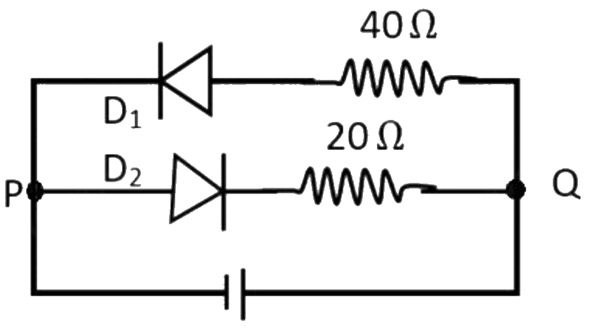
A 4 V battery is connected across points P and Q as shown in figure. Assuming that diodes are ideal, the current supplied by battery is:
Answer & explanation
Correct answer: option 3
The correct answer is Option (3) → 0.1 A
An ideal diode has zero resistance when forward biased and infinite resistance when reverse biased, so only a branch whose diode points from the positive end to the negative end carries current. The answer given by NTA takes Q as the positive end of the battery.
Diode D1 (with 40 Ω) points from Q towards P, so it is forward biased and conducts.
Diode D2 (with 20 Ω) points from P towards Q, so it is reverse biased and no current flows in that branch.
\( \displaystyle I = \frac{V}{R} = \frac{4\,\mathrm{V}}{40\,\Omega} \)
\( I = 0.1\,\mathrm{A} \)
Note: The two plates of the cell symbol in the figure are drawn almost the same length, so the figure does not show clearly which terminal is positive. The answer given by NTA takes Q as the positive end. If P is taken as the positive end, D2 conducts and D1 does not, and Option (2) is correct:
\( \displaystyle I = \frac{4\,\mathrm{V}}{20\,\Omega} = 0.2\,\mathrm{A} \)