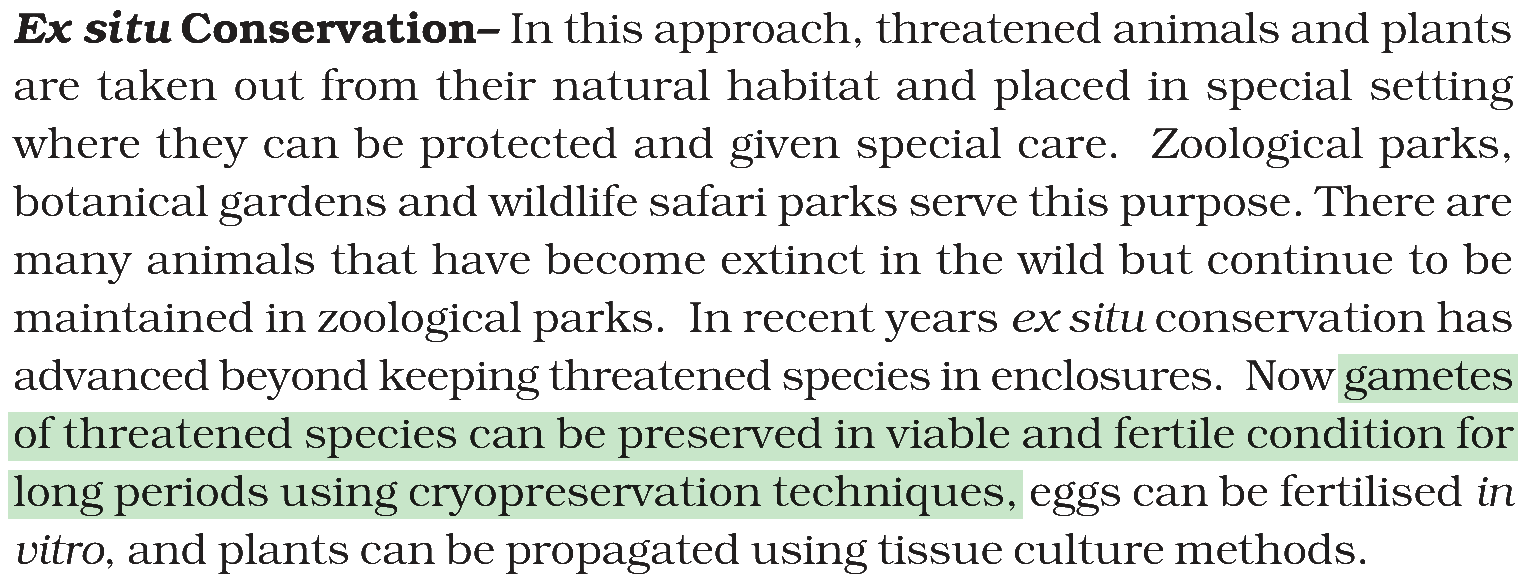
The gametes of threatened species can be preserved in viable and fertile condition for long periods using:
Answer & explanation
Correct answer: option 1
The correct answer is Option (1) → Cryopreservation
Threatened species are also protected away from their natural home, which is called ex situ conservation. One method is to store gametes (sperms and eggs) at very low temperature, so that they stay alive and can later be used for fertilisation.
(1) Cryopreservation — Correct. Cryopreservation means freezing living cells at a very low temperature, usually in liquid nitrogen. Gametes kept this way remain viable and fertile for long periods.
(2) Computed tomography — Incorrect. This is a body-scanning method that uses X-rays. It stores nothing.
(3) In vivo fertilization — Incorrect. This means fertilisation inside the body. It does not preserve gametes. Eggs of threatened species are fertilised in vitro, outside the body, after they have been preserved.
(4) Tissue culture propagation — Incorrect. This grows new plants from plant parts. It is used to multiply plants, not to store gametes.
NCERT Extract:
How Do We Conserve Biodiversity? – “… Now gametes of threatened species can be preserved in viable and fertile condition for long periods using cryopreservation techniques, eggs can be fertilised in vitro, and plants can be propagated using tissue culture methods.”