
Solve the following linear programming problem graphically:
Minimise $Z = 3x+5y$ subject to the constraints: $x + 2y ≥ 10, x + y ≥ 6, 3x + y ≥ 8, x, y ≥ 0$.
Answer & explanation
Correct answer: option 1
The correct answer is Option (1) → $Z=26$ at $(2,4)$
We are required to minimise $Z = 3x+5y$, subject to the constraints :
$x + 2y ≥ 10, x + y ≥ 6, 3x + y ≥ 8, x≥ 0, y ≥ 0$.
Draw the lines $x + 2y = 10, x + y = 6$ and $3x + y = 8$.
Shade the region satisfied by the given inequalities.
The shaded region in the adjoining figure gives the feasible determined by the given inequalities.
Solving $x + 2y = 10$ and $x + y = 6$ simultaneously, we get $x = 2$ and $y = 4$.
Solving $x + y = 6$ and $3x + y = 8$ simultaneously, we get $x = 1, y = 5$.
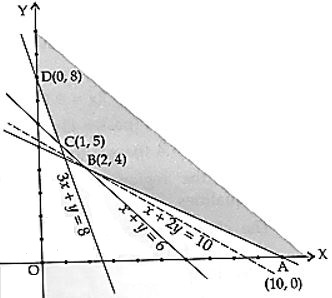
We observe that the feasible region is unbounded and the corner points are A(10, 0), B(2, 4), C(1, 5) and D(0, 8).
At the corner points, the values of Z are:
at $A(10, 0), Z = 3.10 + 5.0 = 30;$
at $B (2, 4), Z = 3.2 + 5.4 = 26;$
at $C(1, 5), Z = 3.1 +5.5 = 28;$
at $D(0, 8), Z = 3.0 +5.8 =40.$
The smallest value of Z is 26 at B (2, 4).
As the feasible region is unbounded, we cannot say whether the minimum value exists or not.
To check whether the smallest value 26 is minimum
We draw the half plane $3x + 5y < 26$ and notice that there is no common point with the feasible region. Hence, 26 is indeed the minimum value.
Hence, the given objective function $Z = 3x + 5y$ has minimum value 26 at B(2, 4).