The working of multiplier moves with :
(A) Δ in Consumption
(B) Δ in Price level
(C) Δ in Rate of interest
(D) Δ in Income
(E) Δ in Investment
Choose the correct answer from the options given below :
Answer & explanation
Correct answer: option 2
The correct answer is Option (2) → (A), (D) and (E) Only
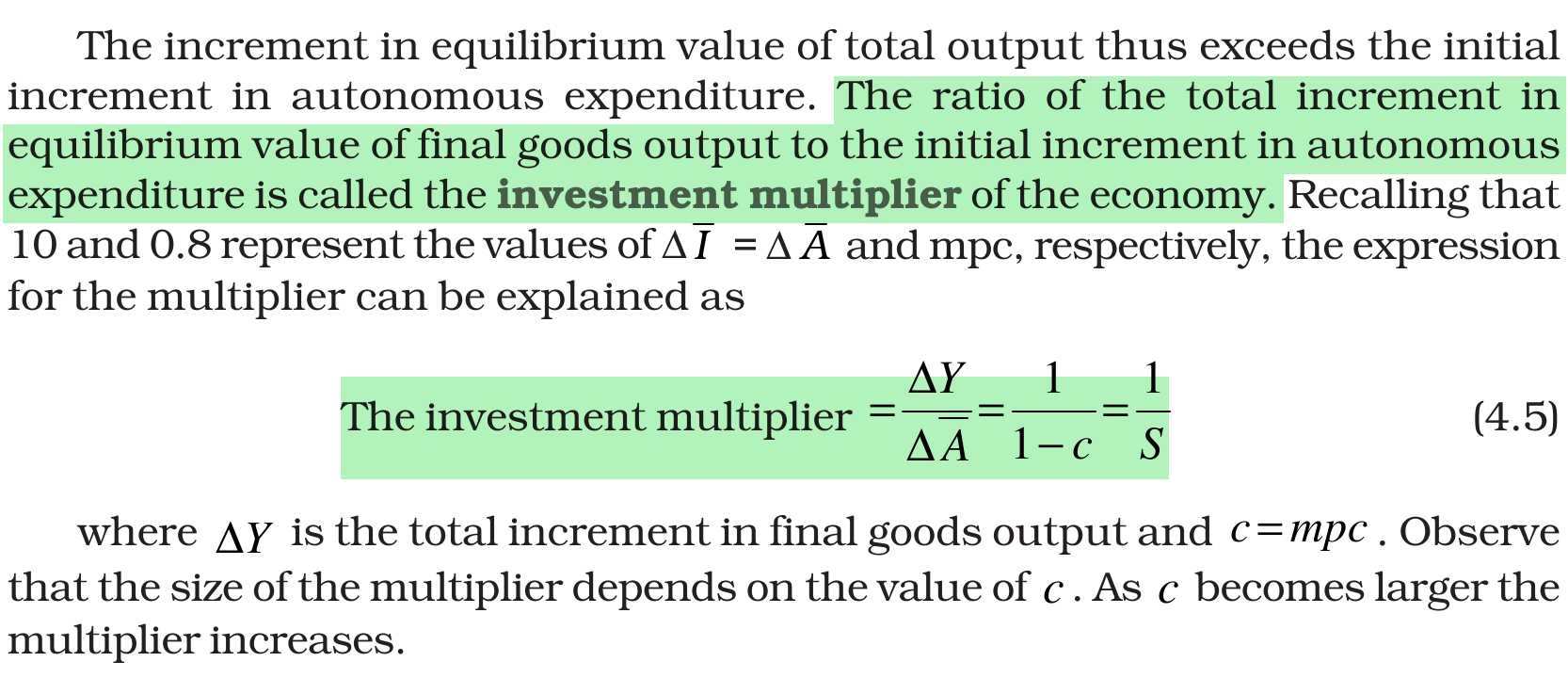
The investment multiplier is the change in income divided by the change in investment, ΔY/ΔI. It works in rounds. A rise in investment raises output and income. People spend a part of the extra income, so consumption rises, and this raises income again.
(A) Δ in Consumption — True. In each round people spend the marginal propensity to consume (MPC) times their extra income. This extra consumption drives the next round.
(B) Δ in Price level — False. In this model the price level is taken as fixed. Output and income rise, while prices stay the same.
(C) Δ in Rate of interest — False. The multiplier is worked out with the rate of interest given. Investment here is autonomous and does not depend on the rate of interest.
(D) Δ in Income — True. The total rise in income is what the multiplier measures. It is many times the first rise in investment.
(E) Δ in Investment — True. A change in autonomous investment starts the whole process.
NCERT (2026-27): “4.3.3 The Multiplier Mechanism It was seen in the previous section that with a change in the autonomous expenditure of 10 units, the change in equilibrium income is equal to 50 units (from 250 to 300). We can understand this by looking at the multiplier mechanism, which is explained below: … In the above example the value of the extra output, 10, is distributed among various factors as factor payments and hence the income of the economy goes up by 10. When income increases by 10, consumption expenditure goes up by (0.8)10, since people spend 0.8 (= mpc) fraction of their additional income on consumption. Hence, in the next round, aggregate demand in the economy goes up by (0.8)10 and there again emerges an excess demand equal to (0.8)10.…”
|