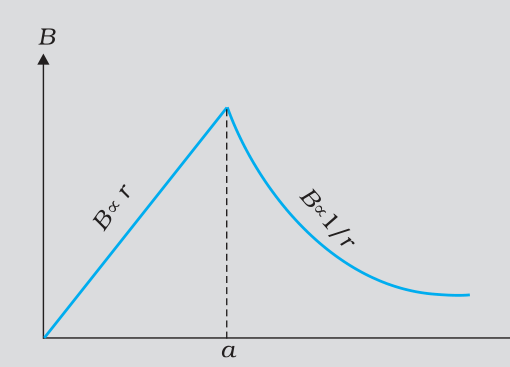
The plot of the magnitude of \( \vec{B} \) (magnetic field) with distance 'r' from the centre of a long straight thick wire carrying steady current I distributed uniformly across its cross-section of radius 'a' is given by:
Answer & explanation
Correct answer: option 1
The correct answer is Option (1)

Use Ampere's circuital law with a circular loop of radius r about the axis of the wire.
Inside the wire (\( r \lt a \)): the loop encloses only the fraction \( r^{2}/a^{2} \) of the current.
\( \displaystyle B\,(2\pi r) = \mu_0 I\,\frac{r^{2}}{a^{2}} \Rightarrow B = \frac{\mu_0 I\,r}{2\pi a^{2}} \propto r \)
Outside the wire (\( r \gt a \)): the loop encloses the whole current.
\( \displaystyle B\,(2\pi r) = \mu_0 I \Rightarrow B = \frac{\mu_0 I}{2\pi r} \propto \frac{1}{r} \)
At \( r = a \) both give \( B = \mu_0I/2\pi a \), the maximum. The graph is therefore a straight line rising from the origin up to \( r = a \), followed by a curve that falls as \( 1/r \), as in Option (1).
Why the other options are incorrect
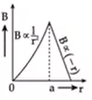
Option (2) — Incorrect. Inside the wire the field rises along a straight line, not a curve, and outside it does not fall along a straight line.

Option (3) — Incorrect. The field outside falls as \( 1/r \), a curve that never reaches zero, not along a straight line down to zero.

Option (4) — Incorrect. The straight rise is right, but outside the wire this graph falls as \( 1/r^{2} \), which is too fast; a long straight current gives \( 1/r \).
Note: A similar question was also asked in CUET (UG) 2023 on 30-05-2023 (Slot 1).
NCERT (2026-27):
Ampere’s Circuital Law – …