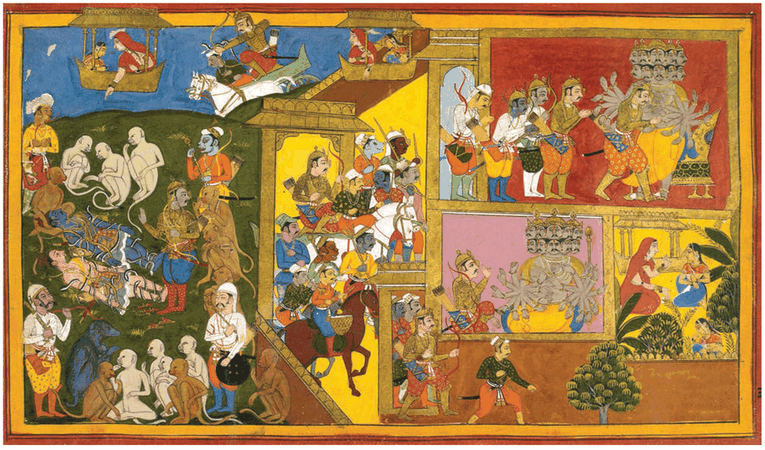
Sahibdin painted the Yuddha Kanda of the Ramayana at Mewar in 1652. Consider the following statements on this work:
(A) It uses oblique aerial perspective to give credibility to the large scale of war pictures.
(B) The artist either layers several episodes into one painting or spreads one episode over more than one folio.
(C) The folio portrays Ravana’s devious tactics and use of magic weapons in war.
(D) Yuddha Kanda, the Book of Battles, is a chapter of the set popularly called the Jagat Singh Ramayana.
Choose the correct answer from the options given below:
Answer & explanation
Correct answer: option 2
The correct answer is Option (2) → (A), (B) and (D) only
(A) It uses oblique aerial perspective to give credibility to the large scale of war pictures. — Correct. Sahibdin crafted this novel pictorial device to make the ambitious scale of war pictures believable.
(B) The artist either layers several episodes into one painting or spreads one episode over more than one folio. — Correct. These are the two narrative techniques Sahibdin deploys.
(C) The folio portrays Ravana’s devious tactics and use of magic weapons in war. — Incorrect. The tactics and magic weapons shown are those of Indrajit, not Ravana.
(D) Yuddha Kanda, the Book of Battles, is a chapter of the set popularly called the Jagat Singh Ramayana. — Correct. The Book of Battles is one chapter of the Ramayana set known as the Jagat Singh Ramayana.
NCERT (2026-27): “Mewar School of Painting …Attributed to ingenious artist Sahibdin, Yuddha Kanda, the Book of Battles, is a chapter in the Ramayana set of paintings, popularly referred to as the Jagat Singh Ramayana. Dated 1652, Sahibdin, herein, has crafted a novel pictorial device that of oblique aerial perspective to impart credibility to the ambitious scale that war pictures encompass. Deploying various narrative techniques, he either layers several episodes into a single painting as this one, or spreads a single episode over more than one folio. This painting portrays Indrajit’s devious tactics and use of magic weapons in war.”
Yuddha Kanda of Ramayana, Sahibdin, Mewar, 1652, India Office Library, London |