
Find the point on the straight line $2x + 3y = 6$, which is closest to the origin.
Answer & explanation
Correct answer: option 3
The correct answer is Option (3) → $\left(\frac{12}{13},\frac{18}{13}\right)$
Let $P (h, k)$ be any point on the line $2x + 3y = 6$, then $2h + 3k = 6$
$⇒k =\frac{6-2h}{3}$ ...(i)
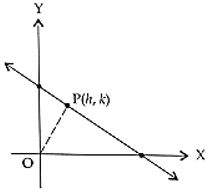
Distance of point P from origin
$= |OP|=\sqrt{(h−0)^2 + (k − 0)^2} = \sqrt{h^2 + k^2}$
$=\sqrt{h^2+\left(\frac{6-2h}{3}\right)^2}$ (using (i))
Now $|OP|$ is shortest iff $|OP|^2$ is shortest.
Let us write $|OP|^2$ as $f(h)$ i.e.
$f(h) = h^2 +\frac{(6 - 2h)^2}{9}=\frac{1}{9}(13h^2 - 24h + 36)$ ...(ii)
Differentiating (ii) w.r.t. h, we get
$f'(h)=\frac{1}{9}(26h-24)$ and $f''(h)=\frac{26}{9}$
$f'(h)=0⇒\frac{1}{9}(26h-24)=0⇒h=\frac{12}{13}$
For $h=\frac{12}{13},f''(h)=\frac{26}{9}>0$
⇒ f(h) is minimum when $h =\frac{12}{13}$
When $h=\frac{12}{13}$, from (i), $k=\frac{6-2×\frac{12}{13}}{3}=\frac{54}{3×13}=\frac{18}{13}$.
Hence, the point on the given line $2x + 3y = 6$ which is closest to the origin is $\left(\frac{12}{13},\frac{18}{13}\right)$.