
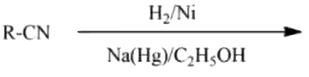
What is the product of the following reaction?
Answer & explanation
Correct answer: option 4
The correct answer is Option (4) → \(R-CH_2-NH_2\)
A nitrile has a carbon–nitrogen triple bond. On reduction, four hydrogen atoms add across it: two to the carbon and two to the nitrogen. The carbon of the –CN group becomes a \( \ce{CH2} \) group and the nitrogen becomes an \( \ce{NH2} \) group, so a primary amine with the same number of carbon atoms is formed. Catalytic hydrogenation (\( \ce{H2/Ni} \)) and sodium amalgam in ethanol both do this:
\( \displaystyle \ce{R-C#N} \xrightarrow[\ce{Na(Hg)/C2H5OH}]{\ce{H2/Ni}} \ce{R-CH2-NH2} \)
So the product is \( \ce{R-CH2-NH2} \). Since the nitrile is often made from an alkyl halide and cyanide, this route raises the carbon chain by one carbon atom (ascent of the amine series).
Why the other options are incorrect
Option (1) \(R-CH_2-OH\) — Incorrect. An alcohol has no nitrogen; it comes from the reduction of an aldehyde, \( \ce{RCHO + H2 -> RCH2OH} \), not of a nitrile.
Option (2) \(R-CO-NH_2\) — Incorrect. The amide is formed by partial hydrolysis of the nitrile, \( \ce{R-C#N + H2O -> R-CO-NH2} \); it is not a reduction product.
Option (3) \(R-NH_2\) — Incorrect. This amine has one carbon atom less; it is obtained from an amide by the Hofmann bromamide reaction, \( \ce{RCONH2 + Br2 + 4NaOH -> RNH2 + Na2CO3 + 2NaBr + 2H2O} \).
NCERT (2026-27 edition):
Reduction of Nitriles
