Based on following case, answer question.
A Ltd issued 2,000, 10% debenture of ₹100 each on April 1, 2019 at a discount of 10% redeemable at a premium of 10% after five years. Company purchased assets of the book value of ₹2,20,000 from B Ltd. at book value and agreed to make payment of purchase consideration by issuing another 2000, 10% Debentures of ₹100 each at a premium of 10% on above mentioned date only.
On 31st March 2020, Premium on Redemption of Debentures will be shown in the Balance Sheet under:
Answer & explanation
Correct answer: option 2
The correct answer is Option (2) → Other long-term liabilities
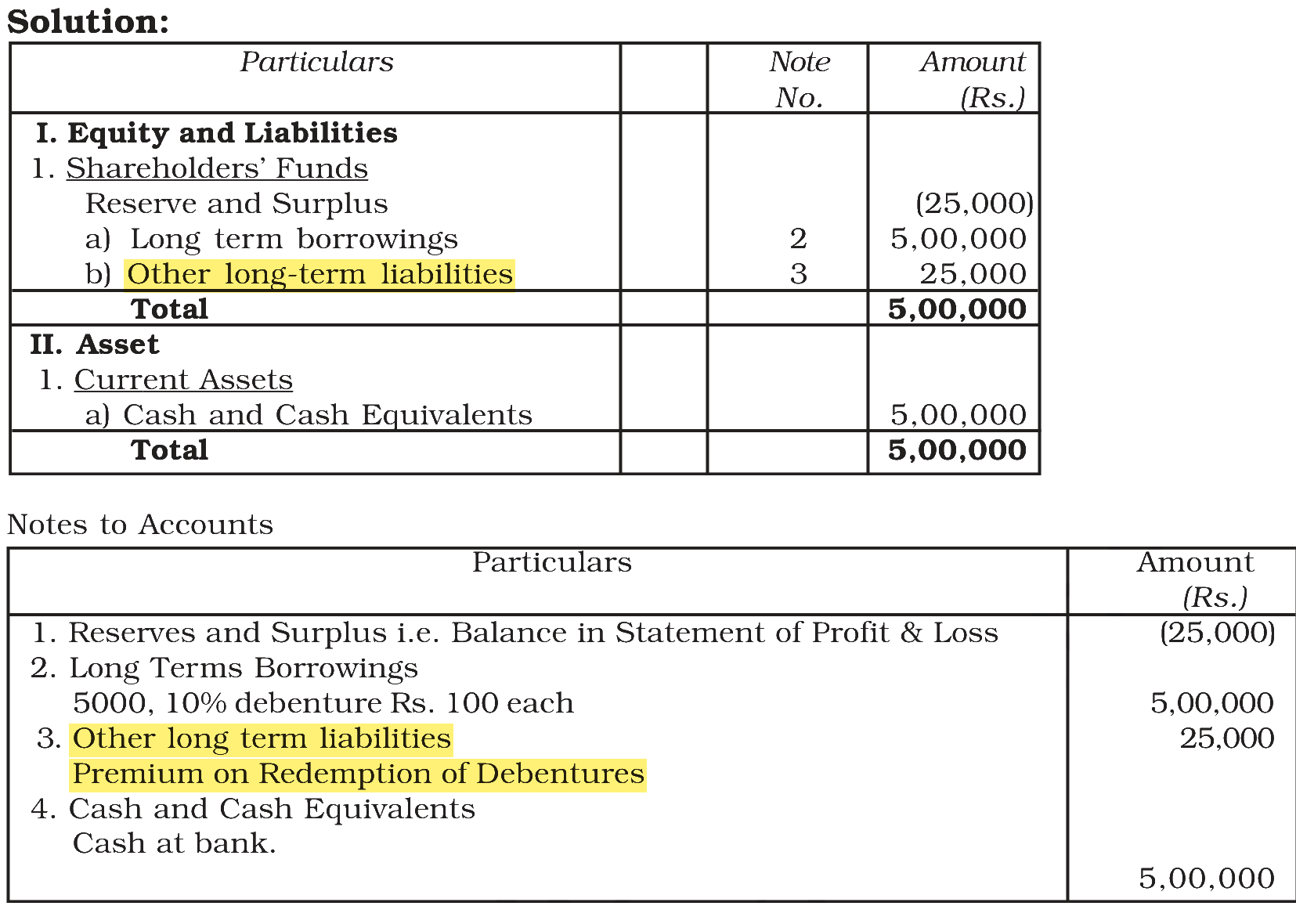
The premium on redemption is a liability the company must pay when the debentures are redeemed, after five years. On 31st March 2020 it is not due within twelve months, so it is a non-current liability. It is not a borrowing in itself, so it is shown under Other long-term liabilities, as in the book’s solved Balance Sheet below.
Option (1) Shareholder's funds — Incorrect. It is an amount payable to debentureholders, not owners’ money.
Option (2) Other long-term liabilities — Correct. It falls due only on redemption, more than a year away.
Option (3) Long term provisions — Incorrect. The amount is known and fixed by the terms of issue; long-term provisions are for items such as employee benefits.
Option (4) Current liabilities — Incorrect. It is not payable within the next twelve months.
Note 1: The chapter text of the NCERT book lists premium on redemption under the sub-head ‘Long-term Borrowings’, which is not among the options; the book’s illustration below shows it under Other long-term liabilities.
Note 2: In the book’s solution below, the head ‘2. Non-current Liabilities’ is missing (a misprint): Long term borrowings and Other long-term liabilities are printed under 1. Shareholders’ Funds, but they belong under Non-current Liabilities.
NCERT (2026-27 edition):
NCERT (2026-27 edition):
|