Choose the correct option with respect to the development in the 1980s and 1990s.
(A) Elections of 1989 marked the end of the Congress system
(B) Assassination of Rajiv Gandhi by LTTE in 1991
(C) New economic reforms were initiated by V.P. Singh
(D) In 1989, the UPA formed the government
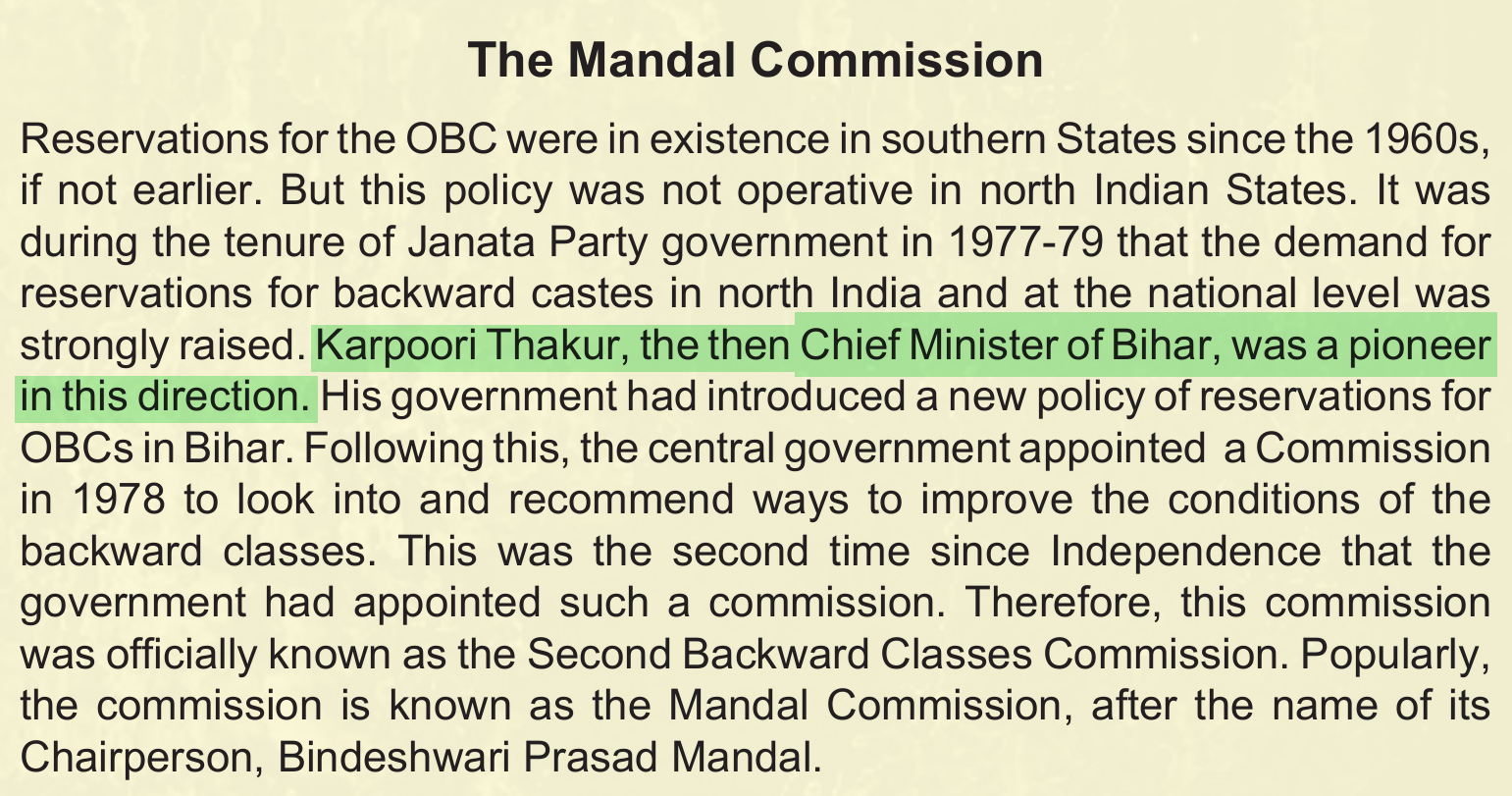
(E) Karpoori Thakur, the then chief minister of Bihar was a pioneer in introducing the policy of reservation.
Answer & explanation
Correct answer: option 2
The correct answer is Option (2) → (A), (B), (E) Only
(A) Elections of 1989 marked the end of the Congress system Correct. The Congress, which had won 415 Lok Sabha seats in 1984, was reduced to 197 in 1989. It came back to power in 1991, but the elections of 1989 marked the end of what political scientists have called the ‘Congress system’.
(B) Assassination of Rajiv Gandhi by LTTE in 1991 Correct. Rajiv Gandhi was assassinated in May 1991 by a Sri Lankan Tamil linked to the LTTE, while on an election campaign tour in Tamil Nadu.
(C) New economic reforms were initiated by V.P. Singh Incorrect. The structural adjustment programme or new economic reforms were started by Rajiv Gandhi and became very visible in 1991.
(D) In 1989, the UPA formed the government Incorrect. In 1989 the National Front (an alliance of the Janata Dal and some regional parties) formed a coalition government, supported from outside by the BJP and the Left Front. The UPA came to power only in 2004.
(E) Karpoori Thakur, the then chief minister of Bihar was a pioneer in introducing the policy of reservation. Correct. Karpoori Thakur, then Chief Minister of Bihar, was a pioneer in this direction: his government introduced a new policy of reservations for OBCs in Bihar.
NCERT (2026-27): “Context of the 1990s … The Congress improved its performance and came back to power soon after the mid-term elections held in 1991. But the elections of 1989 marked the end of what political scientists have called the ‘Congress system’. To be sure, the Congress remained an important party and ruled the country more than any other party even in this period since 1989. But it lost the kind of centrality it earlier enjoyed in the party system. Context of the 1990s … This is known as the initiation of the structural adjustment programme or the new economic reforms. Started by Rajiv Gandhi, these changes first became very visible in 1991 and radically changed the direction that the Indian economy had pursued since Independence.… Context of the 1990s … Finally, the assassination of Rajiv Gandhi in May 1991 led to a change in leadership of the Congress party. He was assassinated by a Sri Lankan Tamil linked to the LTTE when he was on an election campaign tour in Tamil Nadu.… Era of Coalitions … The National Front (which itself was an alliance of Janata Dal and some other regional parties) received support from two diametrically opposite political groups: the BJP and the Left Front. On this basis, the National Front formed a coalition government, but the BJP and the Left Front did not join in this government.”
|