
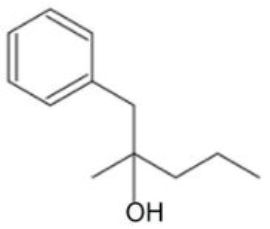
The substrates required for the preparation of the following alcohol are
Answer & explanation
Correct answer: option 4
The correct answer is Option (4) → \( \ce{CH3CH2CH2MgBr} \) and 1-phenylpropan-2-one
A Grignard reagent adds to a ketone to give a tertiary alcohol: the alkyl group of R′MgX bonds to the carbonyl carbon, and hydrolysis of the adduct gives the –OH group. The carbinol carbon of the product carries the two groups of the ketone and the group from the Grignard reagent.
The alcohol here is \( \ce{C6H5CH2-C(CH3)(OH)-CH2CH2CH3} \) (2-methyl-1-phenylpentan-2-ol). Its carbinol carbon carries a benzyl, a methyl and a propyl group. Taking the propyl group from the Grignard reagent, the ketone must carry the benzyl and methyl groups, which is 1-phenylpropan-2-one:
\( \displaystyle \ce{C6H5CH2COCH3 + CH3CH2CH2MgBr} \xrightarrow{\text{dry ether}} \ce{C6H5CH2C(CH3)(OMgBr)CH2CH2CH3} \)
\( \displaystyle \ce{C6H5CH2C(CH3)(OMgBr)CH2CH2CH3} \xrightarrow{\ce{H3O^+}} \ce{C6H5CH2C(CH3)(OH)CH2CH2CH3 + Mg(OH)Br} \)
So the substrates are propylmagnesium bromide and 1-phenylpropan-2-one.
Why the other options are incorrect
Option (1) \( \ce{CH3MgBr} \) and 1-phenylbutan-2-one — Incorrect. This gives \( \ce{C6H5CH2C(CH3)(OH)CH2CH3} \), which has an ethyl group in place of the propyl group.
Option (2) \( \ce{C6H5MgBr} \) and butan-2-one — Incorrect. This gives \( \ce{C6H5C(CH3)(OH)CH2CH3} \), with the phenyl group bonded straight to the carbinol carbon and no \( \ce{CH2} \) between them.
Option (3) \( \ce{CH3MgBr} \) and 1-phenylbutan-1-one — Incorrect. This gives \( \ce{C6H5C(CH3)(OH)CH2CH2CH3} \); again the phenyl group sits on the carbinol carbon instead of a benzyl group.