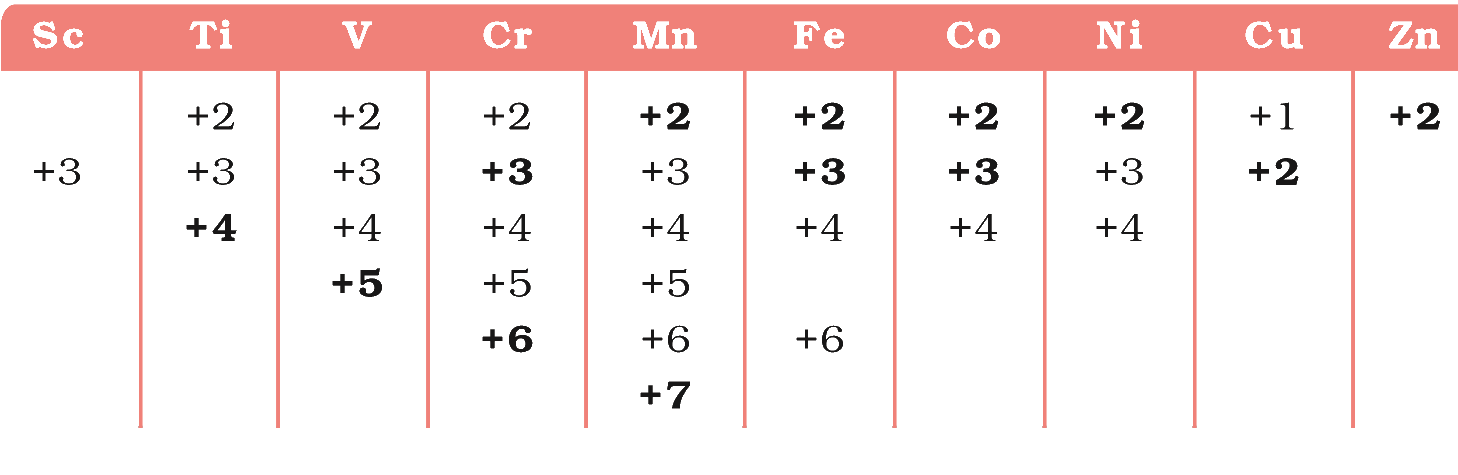
Match the LIST-I with LIST-II.
| LIST-I Metal | LIST-II Highest oxidation state |
| A. Mn | I. +2 |
| B. Cr | II. +5 |
| C. V | III. +7 |
| D. Cu | IV. +6 |
Choose the correct answer from the options given below:
Answer & explanation
Correct answer: option 4
The correct answer is Option (4) → A-III, B-IV, C-II, D-I
In the first half of the 3d series, the highest oxidation state of a metal equals the total number of its 4s and 3d electrons, because all of them can take part in bonding. After Mn this no longer holds, since the d orbitals begin to pair up and hold their electrons more firmly.
A. Mn — This matches III. +7. Mn (Z = 25) is [Ar]3d54s2; losing all 5 + 2 = 7 electrons gives +7, as in \( \ce{KMnO4} \).
B. Cr — This matches IV. +6. Cr (Z = 24) is [Ar]3d54s1; losing all 5 + 1 = 6 electrons gives +6, as in \( \ce{K2Cr2O7} \).
C. V — This matches II. +5. V (Z = 23) is [Ar]3d34s2; losing all 3 + 2 = 5 electrons gives +5, as in \( \ce{V2O5} \).
D. Cu — This matches I. +2. Cu (Z = 29) is [Ar]3d104s1; it loses the 4s electron and one 3d electron to give \( \ce{Cu^{2+}} \): 3d9. The filled d subshell holds its other electrons firmly, so +2 is its usual highest state, as in \( \ce{CuSO4} \).
Shortcut: The pair C–II appears only in Option (4).
NCERT (2026-27 edition):
Oxidation States – …