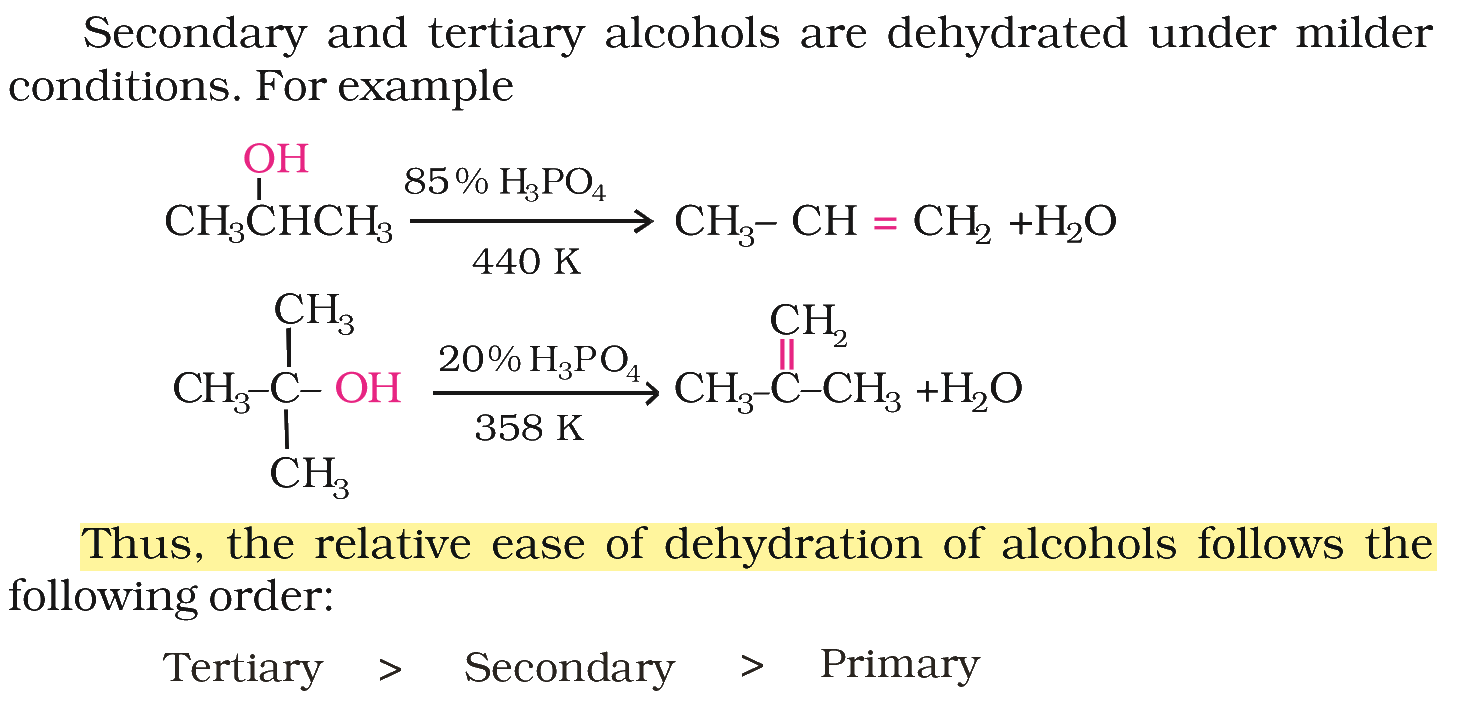
The relative order of reactivity of \(1^o , 2^o, 3^o\) alcohol towards dehydration is :
Answer & explanation
Correct answer: option 4
The correct answer is Option (4) → \(3^o > 2^o > 1^o\)
Acid-catalysed dehydration of an alcohol to an alkene goes through a carbocation:
\( \ce{R-OH + H+ -> R-OH2+} \xrightarrow{\text{slow}} \ce{R+ + H2O} \), then \( \ce{R^{+}} \) loses \( \ce{H^{+}} \) from the next carbon to give the alkene.
The carbocation step is the slow step, so the more stable the carbocation, the easier the dehydration. Alkyl groups stabilise the positive charge (+I effect and hyperconjugation): 3° > 2° > 1° carbocation. A primary alcohol such as ethanol needs concentrated \( \ce{H2SO4} \) at 443 K; secondary and tertiary alcohols react under milder conditions; propan-2-ol, for example, needs only 85% \( \ce{H3PO4} \) at 440 K.
Shortcut: only Option (4) begins with 3°, the alcohol that forms the most stable carbocation.
NCERT (2026-27 edition):
Dehydration – …