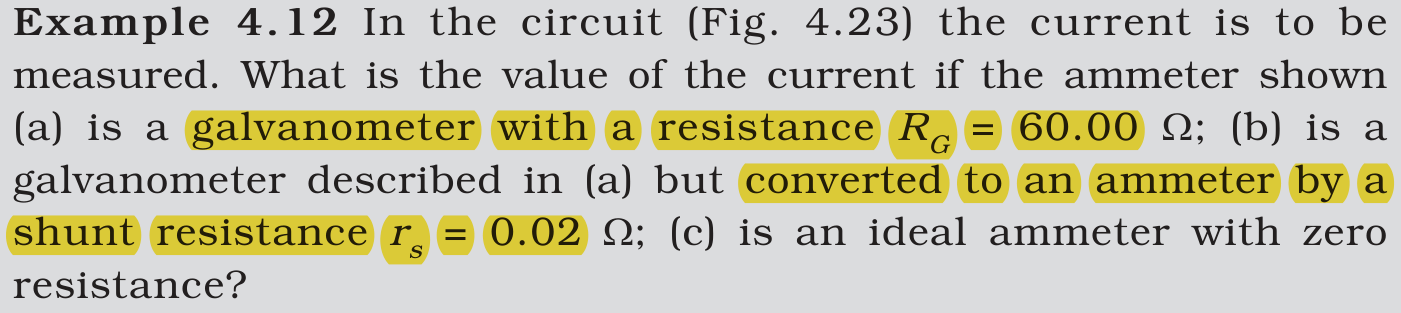
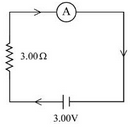
In the circuit shown, value of current in the circuit if the ammeter shown is made by a galvanometer of resistance 60.00 Ω and a shunt resistance of 0.02 Ω is:
Answer & explanation
Correct answer: option 2
The correct answer is Option (2) → 0.99 A
An ammeter made from a galvanometer and a shunt in parallel has an effective resistance smaller than either of them. This resistance is in series with the \( 3.00\,\Omega \) resistor and the \( 3.00\,\mathrm{V} \) cell. The cell is taken as ideal (no internal resistance).
\( \displaystyle R_A = \frac{R_gS}{R_g+S} = \frac{60\times0.02}{60+0.02}\,\Omega \approx 0.02\,\Omega \)
By Ohm’s law for the whole series circuit:
\( \displaystyle I = \frac{\varepsilon}{R+R_A} = \frac{3.00\,\mathrm{V}}{3.00\,\Omega+0.02\,\Omega} = 0.993\,\mathrm{A}\approx0.99\,\mathrm{A} \)
Shortcut: Without the ammeter the current would be \( 3/3 = 1\,\mathrm{A} \). Any ammeter adds some resistance, so the current must come out slightly below 1 A. This rules out Options (3) and (4) at once. Option (1), 0.048 A, is \( 3/(3+60) \), the current if the \( 60\,\Omega \) galvanometer were used alone without the shunt, so only 0.99 A fits.
Note: This question is from NCERT (2026-27). NTA sets numerical questions from NCERT too, so do not ignore NCERT while practising numericals.
NCERT (2026-27):
The Moving Coil Galvanometer – …