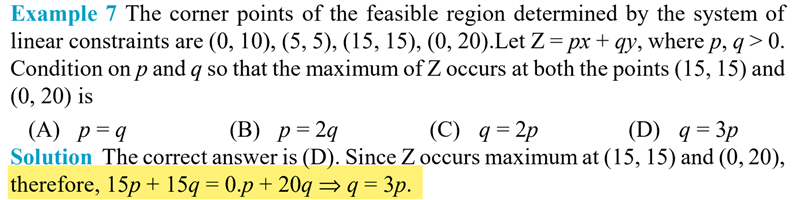
The corner points of the bounded feasible region determined by the system of linear constraints are (0, 8), (4, 4), (12, 12), (0, 20). Let \(z = px + qy\), where \(p, q\gt 0\). Condition on \(p\) and \(q\) so that the maximum of \(z\) occurs at both the points (12, 12), (0, 20) is
Answer & explanation
Correct answer: option 4
The correct answer is Option (4) → \(3p = 2q\)
If the maximum occurs at two corner points, z must have the same value at both:
\(z(12, 12) = 12p + 12q\)
\(z(0, 20) = 20q\)
\(12p + 12q = 20q\)
\(12p = 8q\)
\(3p = 2q\)
This common value is indeed the maximum: with \(q = \frac{3p}{2}\), z is \(12p\) at (0, 8), \(10p\) at (4, 4) and \(30p\) at both (12, 12) and (0, 20).
Why the other options are incorrect
Option (1) \(2p=q\) — Incorrect. With \(q = 2p\), \(z(12, 12) = 36p\) but \(z(0, 20) = 40p\).
Option (2) \(p =3q\) — Incorrect. With \(p = 3q\), \(z(12, 12) = 48q\) but \(z(0, 20) = 20q\).
Option (3) \(2p=3q\) — Incorrect. This inverts the ratio: with \(p = \frac{3q}{2}\), \(z(12, 12) = 30q\) but \(z(0, 20) = 20q\).
NCERT Exemplar:
Linear Programming