
CUETMOCK
  • Pricing
  • Mentors
Log inStart freeStart free mocks→

First test, then trust

Try a free CUET mock test.

Join 5,00,000+ students who rehearsed exam day on the exact NTA screen before sitting CUET. On the web and on Android.

Start free mocks →Get the Android app
CUETMOCK

India's #1 CUET Mock Test Platform. Original NCERT-based questions on the exact NTA exam screen — trusted by 5,00,000+ students since CUET 2022.

Get it onGoogle PlayScan to download the CUETMOCK app

Mock tests

  • CUET mock test series
  • Commerce mocks
  • Humanities (Arts) mocks
  • Science mocks
  • Languages & GAT mocks
  • Free practice questions
  • Pricing

Resources

  • CUET exam guide
  • CUET syllabus
  • Universities accepting CUET
  • Expert blogs
  • News & notifications
  • Webinars & counselling
  • CUET score calculator
  • How we estimate your rank
  • FAQs

Company

  • About us
  • Our leadership & team
  • Our toppers
  • Mentors
  • For schools
  • Contact us
  • Terms
  • Privacy
  • Refund policy

Talk to us

+91 7696 6630 56info@cuetmock.comWhatsApp us

Our other platforms

  • JEE Mock — For IIT-JEE aspirants
  • NEET Mock — For NEET aspirants

Newsletter

Exam updates, study material and offers — no spam.

© 2026 NYC Ventures Pvt. Ltd.

701-702, Royal Business Park, Zirakpur, Punjab - 140603

  • Terms of use
  • Privacy policy
  • Refund policy
  • Contact us

iCUETMOCK is an independent preparation platform, not affiliated with the National Testing Agency (NTA). Always check exam details on the official NTA website.

  • Home
  • Mock tests
  • CUET guide
  • Pricing
  • Log in
Home/Practice questions/Biology
BiologySexual Reproduction in Flowering Plants

Identify the correct description of the given figure:
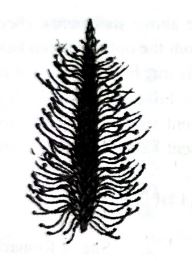
Identify the correct description of the given figure:

Answer & explanation+

Correct answer: option 2

The correct answer is Option (2) → Wind-pollinated plant inflorescence with flowers featuring well-exposed stamens.

The figure shows many small flowers packed on one axis (an inflorescence), with long stamens hanging out on all sides. Flowers pollinated by wind have such well-exposed stamens, so that the light, non-sticky pollen is easily carried away by air currents. They also have large, often feathery stigmas to catch pollen from the air.

Option (1) Water-pollinated flowers with stamens covered in a mucilaginous coating. — Incorrect. In water-pollinated plants such as Vallisneria and Hydrilla, it is the pollen grains that have a mucilaginous covering, which protects them from wetting. Such plants do not show tufts of exposed stamens in the air, as the figure does.

Option (2) Wind-pollinated plant inflorescence with flowers featuring well-exposed stamens. — Correct. An inflorescence with numerous flowers and well-exposed stamens is the book’s description of a wind-pollinated plant. The exposed stamens let the pollen be dispersed into wind currents.

Option (3) Cleistogamous flowers exhibiting self-pollination (autogamy). — Incorrect. Cleistogamous flowers do not open at all. Their anthers and stigma lie close together inside the closed flower, so the stamens are never exposed. The figure shows open flowers with stamens sticking out.

Option (4) Dense inflorescence demonstrating complete self-pollination (autogamy). — Incorrect. Autogamy is the transfer of pollen to the stigma of the same flower. Stamens spread out into the air release pollen to be carried away by the wind, which helps cross-pollination, not complete self-pollination.

NCERT Extract:
Pollination – “… Pollination by wind is more common amongst abiotic pollinations. Wind pollination also requires that the pollen grains are light and non-sticky so that they can be transported in wind currents. They often possess well-exposed stamens (so that the pollens are easily dispersed into wind currents, Figure 1.10) and large often-feathery stigma to easily trap air-borne pollen grains. Wind-pollinated flowers often have a single ovule in each ovary and numerous flowers packed into an inflorescence; a familiar example is the corn cob – the tassels you see are nothing but the stigma and style which wave in the wind to trap pollen grains.”
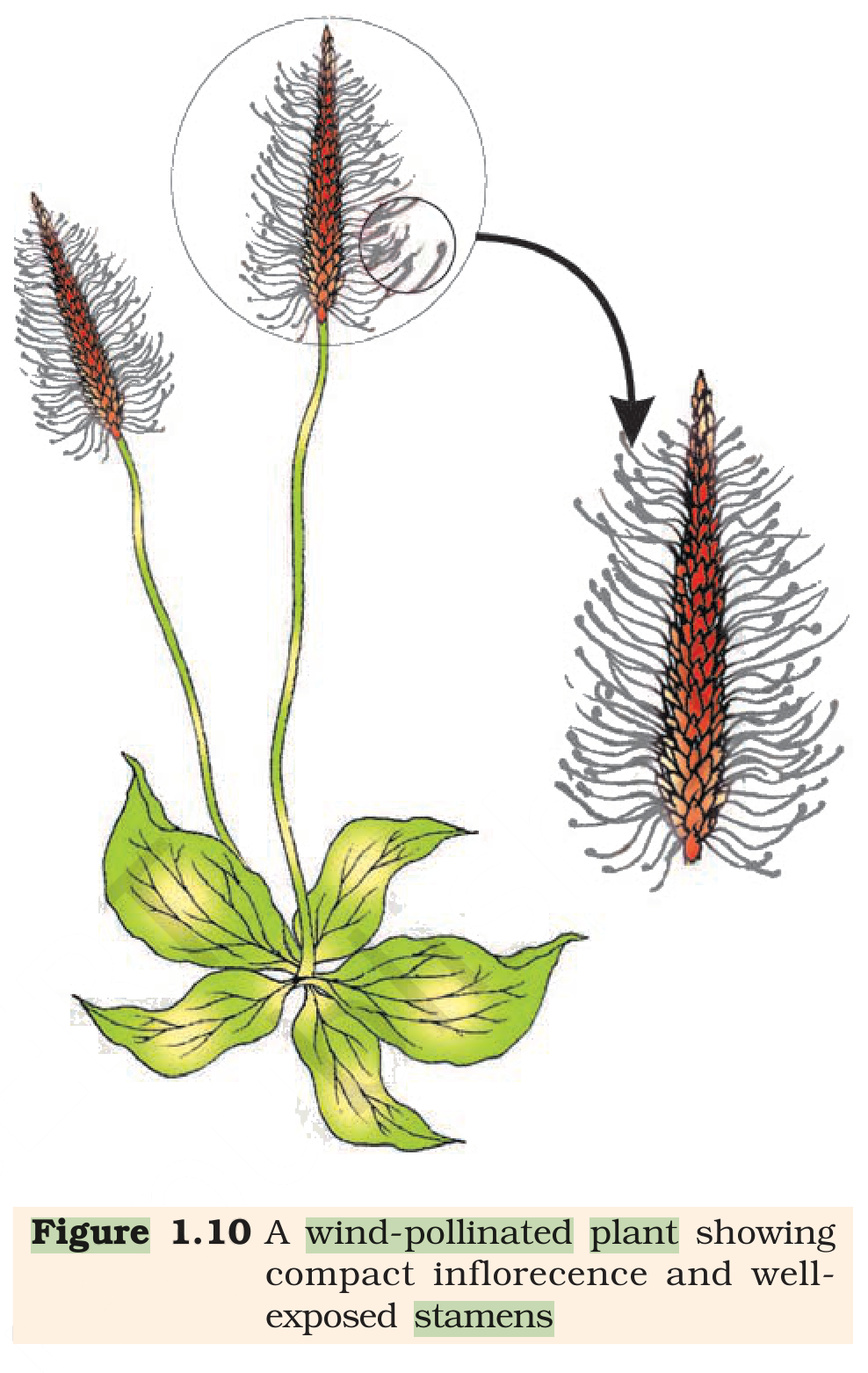
NCERT Figure 1.10

Advertisement

Practise more on Sexual Reproduction in Flowering Plants

Chapter-wise mocks on the real NTA exam screen, with solutions and your rank. Your first mocks are free.

Start free mocks →

Advertisement

Next questions

  1. According to Max Weber, on what basis classes and status groups are differentiated?Sociology · Indian Society: Market as a social Institution
  2. Which of the following answer figure will continue the series given in the question figure?General Aptitude Test · Verbal Reasoning
  3. What is the significance of political conditions in business success?Business Studies · Business Environment
  4. The first cross country gas pipeline constructed by GAIL is :Geography · India-People and Economy: Transport and Communcation
  5. The site of Harappa is located on which river?General Aptitude Test · General Knowledge
  6. Which of the following was the main feature of Jawaharlal Nehru's foreign policy?Political Science · Politics in India Since Independence: India's External Relations
  7. Which mode of transportation has the advantage of taking the least time for carriage and handling high-value or perishable goods over long…Geography · India-People and Economy: International Trade
  8. Which of the following statements is correct about the principle of treating equals equally? Statement A) The principle of treating equals…Political Science · Social Justice
  9. Select the most appropriate ANTONYM of the given word. BarbaricEnglish · Antonyms
  10. Because of the law of diminishing marginal rate of substitution, an indifference curve is:Economics · Micro Economics: Theory of Consumer behaviour