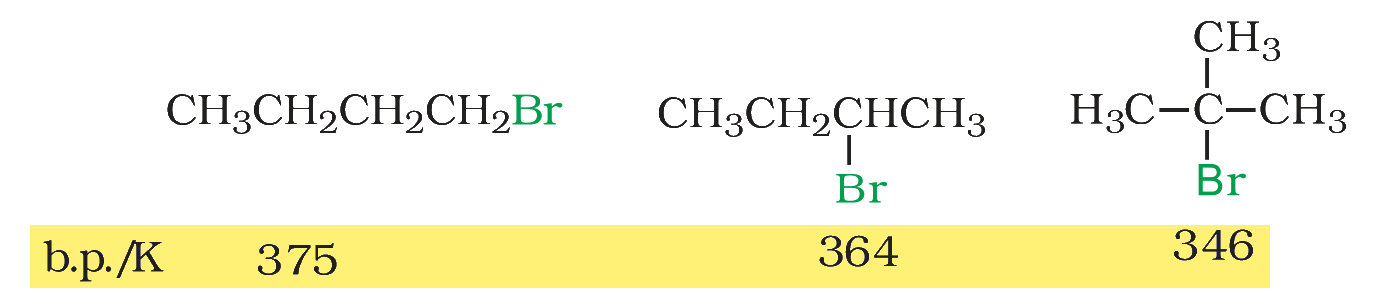
Arrange the compounds in order of their increasing boiling points.
(A) 1-bromoethane
(B) 1-bromobutane
(C) 2-bromo-2-methylpropane
(D) 2-bromobutane
Choose the correct answer from the options given below:
Answer & explanation
Correct answer: option 1
The correct answer is Option (1) → (A), (C), (D), (B)
The boiling point of a haloalkane depends on the strength of the forces between its molecules (dipole–dipole and van der Waals forces). Two factors decide it here:
Size of the molecule: a bigger molecule with more electrons has stronger van der Waals forces, so the boiling point rises with the number of carbon atoms.
Branching (in isomers): branching makes the molecule more compact, nearly spherical. Its surface area of contact becomes smaller, the forces become weaker and the boiling point falls.
(A) 1-bromoethane — first (lowest). CH3CH2Br has only two carbon atoms. It is the smallest molecule of the four, so its van der Waals forces are the weakest (b.p. 311 K).
(C) 2-bromo-2-methylpropane — second. (CH3)3CBr is a C4 bromide, but it is the most branched of the three isomers. Its compact shape gives the smallest contact area among them (b.p. 346 K).
(D) 2-bromobutane — third. CH3CH2CHBrCH3 has one branch (Br on the second carbon), so it is less compact than (C) and boils higher (b.p. 364 K).
(B) 1-bromobutane — last (highest). CH3CH2CH2CH2Br is the straight-chain isomer. It has the largest surface area of contact and the strongest van der Waals forces (b.p. 375 K).
NCERT (2026-27 edition):
Melting and boiling points – “The attractions get stronger as the molecules get bigger in size and have more electrons. …
The boiling points of isomeric haloalkanes decrease with increase in branching. For example, 2-bromo-2-methylpropane has the lowest boiling point among the three isomers.”