
CUETMOCK
  • Pricing
  • Mentors
Log inStart freeStart free mocks→

First test, then trust

Try a free CUET mock test.

Join 5,00,000+ students who rehearsed exam day on the exact NTA screen before sitting CUET. On the web and on Android.

Start free mocks →Get the Android app
CUETMOCK

India's #1 CUET Mock Test Platform. Original NCERT-based questions on the exact NTA exam screen — trusted by 5,00,000+ students since CUET 2022.

Get it onGoogle PlayScan to download the CUETMOCK app

Mock tests

  • CUET mock test series
  • Commerce mocks
  • Humanities (Arts) mocks
  • Science mocks
  • Languages & GAT mocks
  • Free practice questions
  • Pricing

Resources

  • CUET exam guide
  • CUET syllabus
  • Universities accepting CUET
  • Expert blogs
  • News & notifications
  • Webinars & counselling
  • CUET score calculator
  • How we estimate your rank
  • FAQs

Company

  • About us
  • Our leadership & team
  • Our toppers
  • Mentors
  • For schools
  • Contact us
  • Terms
  • Privacy
  • Refund policy

Talk to us

+91 7696 6630 56info@cuetmock.comWhatsApp us

Our other platforms

  • JEE Mock — For IIT-JEE aspirants
  • NEET Mock — For NEET aspirants

Newsletter

Exam updates, study material and offers — no spam.

© 2026 NYC Ventures Pvt. Ltd.

701-702, Royal Business Park, Zirakpur, Punjab - 140603

  • Terms of use
  • Privacy policy
  • Refund policy
  • Contact us

iCUETMOCK is an independent preparation platform, not affiliated with the National Testing Agency (NTA). Always check exam details on the official NTA website.

  • Home
  • Mock tests
  • CUET guide
  • Pricing
  • Log in
Home/Practice questions/Biology
BiologyMolecular Basis of Inheritance

To form a nucleoside, the nitrogenous base is linked to the:

DNA STRUCTURE

Read the following passage carefully and answer the given questions.

DNA is a long polymer of deoxyribonucleotides. A nucleotide has three components – a nitrogenous base, a pentose sugar, and a phosphate group. There are two types of nitrogenous bases – Purines and Pyrimidines. DNA is made of two polynucleotide chains, where the backbone is constituted by sugar-phosphate, and the bases project inside. The bases in two strands are paired through hydrogen bond forming base pairs. As a result, always a purine comes opposite to a pyrimidine. This generates approximately uniform distance between the two strands of the helix. The plane of one base pair stacks over the other in double helix. This, in addition to H-bonds, confers stability of the helical structure. The two polynucleotide chains are coiled in a right-handed fashion. In eukaryotes, the DNA organisation is much more complex. There is a set of positively charged, basic proteins called histones. A protein acquires charge depending upon the abundance of amino acids residues with charged side chains.

To form a nucleoside, the nitrogenous base is linked to the:

Answer & explanation+

Correct answer: option 2

The correct answer is Option (2) → OH of 1′C pentose sugar

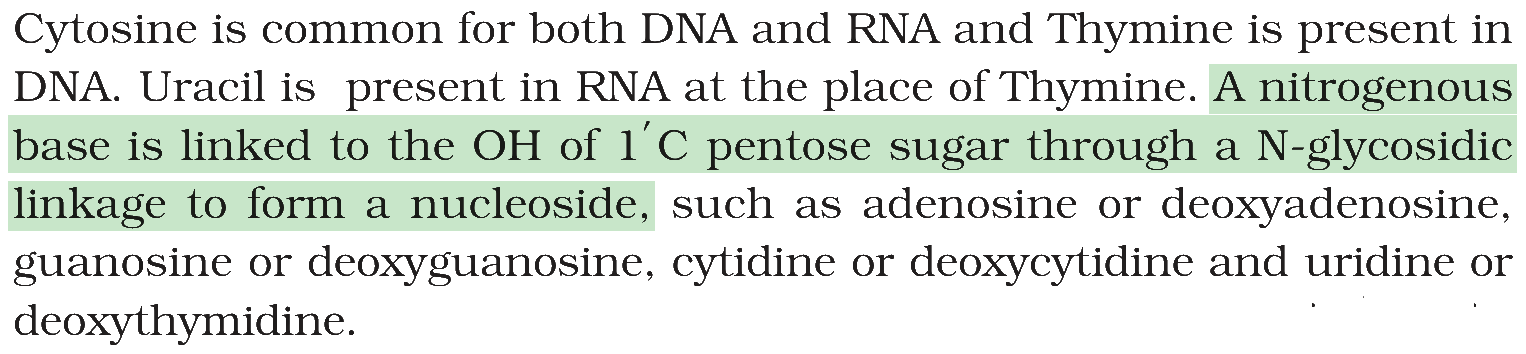
A nucleoside is a nitrogenous base joined to a pentose sugar. The base is linked to the OH of the 1′ carbon of the sugar by an N-glycosidic linkage. Examples are adenosine and guanosine. When a phosphate group is then joined to the OH of the 5′ carbon, a nucleotide is formed.

(1) OH of 3′C pentose sugar — Incorrect. The 3′ carbon is where the next nucleotide is joined, by a 3′-5′ phosphodiester linkage.

(2) OH of 1′C pentose sugar — Correct. This is where the base is attached.

(3) OH of 4′C pentose sugar — Incorrect. The base is not attached at this carbon.

(4) OH of 2′C pentose sugar — Incorrect. The 2′ carbon carries an extra OH in the ribose of RNA. It is not where the base joins.

Note 1: The passage is taken from NCERT. NTA has put lines of the NCERT text together to make it. Most CUET (UG) questions come straight from NCERT, so study the book line by line, including figures and their titles.

Note 2: A similar question was also asked in CUET (UG) 2026 on 06-06-2026 (Slot 1) and on 26-05-2026 (Slot 1).

NCERT Extract:
Structure of Polynucleotide Chain – …
Textbook extract

Advertisement

Practise more on Molecular Basis of Inheritance

Chapter-wise mocks on the real NTA exam screen, with solutions and your rank. Your first mocks are free.

Start free mocks →

Advertisement

Next questions

  1. Which of the following are NOT true?(A) Worker-Population ratio enables us to know the attachment a worker has with his or her job and the…Economics · Indian Economic Development: Employment - Growth, Informalisation and Other Issues
  2. Choose the correctly spelt word.English · Spelling Check
  3. The correct sequence A, B, C, D, E with reference to atomic spectral series is:(A) Lyman series displaystyle1/(λ) = R≤ft(1/(A^2) - 1/(n^2))…Physics · Atoms
  4. Arrange the following events chronologically, starting from the oldest:A. Pakistan's first five-year planB. Formation of the People's Repub…Economics · Indian Economic Development: Comparative Development Experiences of India and its Neighbours
  5. In an examination, the average marks of 40 students is 72. Afterwards it is found that the marks of three students are recorded as 68, 65 a…General Aptitude Test · Numerical Ability
  6. In a certain code language, if Grapes is called Grass, Grass is called Jasmine, Jasmine is called Jaggery, Jaggery is called Melon, and Mel…General Aptitude Test · Verbal Reasoning
  7. A person complaining of stomach ache, weakness and sustained high fever was recommended Widal test by the doctor. Identify the pathogen res…Biology · Human Health and Disease
  8. Choose the statement that is not a characteristic feature of Social Movement:Sociology · Social Change and Development in India: Social Movements
  9. What made the first general election in India unusual compared to previous democracies in the world?a) The size of the country and electora…Political Science · Politics in India Since Independence: Era of one Party Dominance
  10. ______ is a process in which impure water is boiled and the steam is collected and condensed in a separate container, leaving many of the s…General Aptitude Test · General Knowledge