
CUETMOCK
  • Pricing
  • Mentors
Log inStart freeStart free mocks→

First test, then trust

Try a free CUET mock test.

Join 5,00,000+ students who rehearsed exam day on the exact NTA screen before sitting CUET. On the web and on Android.

Start free mocks →Get the Android app
CUETMOCK

India's #1 CUET Mock Test Platform. Original NCERT-based questions on the exact NTA exam screen — trusted by 5,00,000+ students since CUET 2022.

Get it onGoogle PlayScan to download the CUETMOCK app

Mock tests

  • CUET mock test series
  • Browse all papers
  • Commerce mocks
  • Humanities (Arts) mocks
  • Science mocks
  • Languages & GAT mocks
  • Free practice questions
  • Pricing

Resources

  • CUET exam guide
  • CUET syllabus
  • Universities accepting CUET
  • Expert blogs
  • News & notifications
  • Webinars & counselling
  • CUET score calculator
  • How we estimate your rank
  • FAQs

Company

  • About us
  • Our leadership & team
  • Our toppers
  • Mentors
  • For schools
  • Contact us
  • Terms
  • Privacy
  • Refund policy

Talk to us

+91 7696 6630 56info@cuetmock.comWhatsApp us

Our other platforms

  • JEE Mock — For IIT-JEE aspirants
  • NEET Mock — For NEET aspirants

Newsletter

Exam updates, study material and offers — no spam.

© 2026 NYC Ventures Pvt. Ltd.

701-702, Royal Business Park, Zirakpur, Punjab - 140603

  • Terms of use
  • Privacy policy
  • Refund policy
  • Contact us

iCUETMOCK is an independent preparation platform, not affiliated with the National Testing Agency (NTA). Always check exam details on the official NTA website.

  • Home
  • Mock tests
  • CUET guide
  • Pricing
  • Log in
Home/Practice questions/Chemistry
ChemistryOrganic: Aldehydes, Ketones and Carboxylic Acids

The correct sequence of reagents for the conversion of 3-nitrobromobe…

Answer the question on basis of passage given below:

Organic compounds containing carbon-oxygen double bonds (C=O) are called carbonyl compounds. These are highly polar molecules. Hence, their boiling points are higher than hydrocarbons and ethers. Aldehydes can be prepared from dehydrogenation or oxidation of alcohols and by reduction of acyl halides. Ketones are prepared by oxidation of secondary alcohols or by hydration of alkynes etc. Aldehydes and ketones undergo nucleophilic addition reaction with a number of nucleophiles such as HCN, NaHSO3, ammonia derivatives. Carboxylic acids are prepared by the oxidation of primary alcohols, aldehydes and alkenes, by hydrolysis of nitriles. Carboxylic acids are more acidic than alcohols and phenols.

The correct sequence of reagents for the conversion of 3-nitrobromobenzene to 3-nitrobenzoic acid is:

Answer & explanation+

Correct answer: option 1

The correct answer is Option (1) → \(Mg/ether, CO_2, H_3O^+\)

A –COOH group can be put in place of a halogen through a Grignard reagent. The aryl bromide reacts with magnesium in dry ether to give the Grignard reagent; this adds to carbon dioxide (dry ice) to give the salt of a carboxylic acid, which on acidification gives the acid:

    3-\( \ce{O2NC6H4Br} \) + Mg → 3-\( \ce{O2NC6H4MgBr} \) (dry ether)

    3-\( \ce{O2NC6H4MgBr} \) + \( \ce{CO2} \) → 3-\( \ce{O2NC6H4COOMgBr} \)

    3-\( \ce{O2NC6H4COOMgBr} \) + \( \ce{H3O^{+}} \) → 3-\( \ce{O2NC6H4COOH} \) (3-nitrobenzoic acid) + Mg(OH)Br

The carbon of \( \ce{CO2} \) becomes the carbon of the new –COOH group, so the sequence is Mg/ether, CO2, H3O+.

Why the other options are incorrect

  • Option (2) \(KCN, LiAlH_4, NaOH\) — Incorrect. The C–Br bond of an aryl halide has partial double-bond character, so KCN does not replace the bromine; and even a nitrile would be reduced by \( \ce{LiAlH4} \) to an amine (–\( \ce{CH2NH2} \)), not converted into an acid.

  • Option (3) \(KMnO_4/OH^-, dil.H_2SO_4,CO_2/H^+\) — Incorrect. Alkaline \( \ce{KMnO4} \) oxidises an alkyl side chain to –COOH; 3-nitrobromobenzene has no carbon side chain, so there is nothing to oxidise.

  • Option (4) \(AgNO_3\) (ammoniacal), \(CO_2, H_3O^+\) — Incorrect. Ammoniacal \( \ce{AgNO3} \) (Tollens’ reagent) oxidises aldehydes; it does not react with an aryl bromide and cannot introduce a carbon atom.

NCERT (2026-27 edition):
From Grignard Reagents
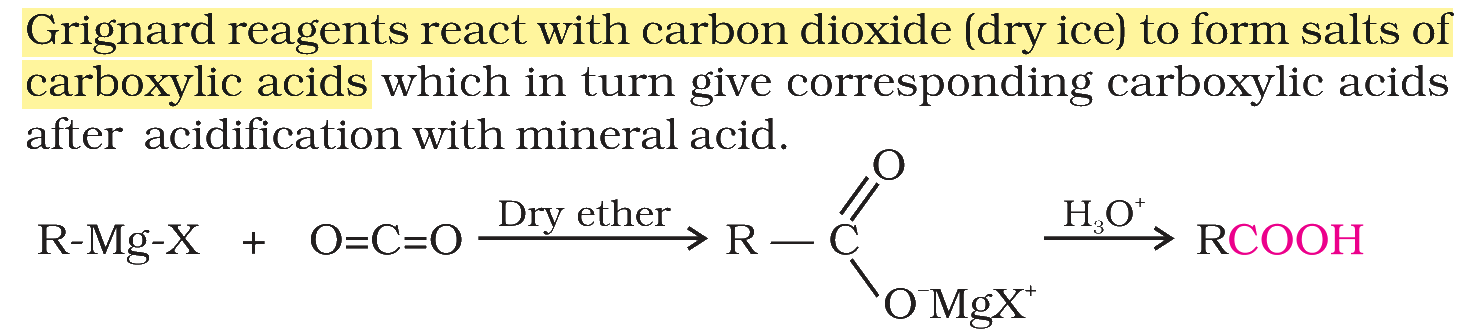
Textbook extract

Note: The same/similar question has been asked in different years by NTA as per the details given below:

20262025202420232022
–––09-06 S3
07-06 S3
31-05 S2
–

Advertisement

Practise more on Organic: Aldehydes, Ketones and Carboxylic Acids

Chapter-wise mocks on the real NTA exam screen, with solutions and your rank. Your first mocks are free.

Start free mocks →

Advertisement

Next questions

  1. National Income is equal to which of the following?(A) NDP at factor cost + Net factor income from abroad(B) NNP at market prices − (Indire…Economics · Macro Economics: National Income Accounting
  2. Which Buddhist text included Buddha's teachings?History · Ancient India: Thinkers, Beliefs and Buildings
  3. AI safety is the need of the hour because:-English · Comprehension - (Narrative / Factual)
  4. Assertion: Consideration has to be adequate and real in a contract. Reasoning: A contract without consideration is not valid.Legal Studies · Topics of Law
  5. Assertion: Mass selection is useful in homozygous plants. Reasoning:: Mass selection does not work with cross-pollinated plants.Biology · Strategies for enhancement in Food production
  6. If L, C and R represent inductance, capacitance and resistance respectively, then which of the following have dimensions of time?(a) L/R (b…Physics · Units and Measurements
  7. A closed rectangular box is made of aluminium sheet of negligible thickness and the length of the box is twice its breadth. If the capacity…Applied Maths. Section B2 · Calculus
  8. Arrange the following religious developments in chronological order: A. Earliest TemplesB. Early Vedic TraditionsC. Early UpanishadsD. Maha…History · Ancient India: Thinkers, Beliefs and Buildings
  9. Which South Asian country became a constitutional monarchy in 2008?Political Science · Contemporary World Politics: Contemporary South Asia
  10. 'मुझे गिलास भर दूध चाहिए' उपर्युक्त रेखांकित पद क्या है:Hindi · व्याकरण - विशेषण