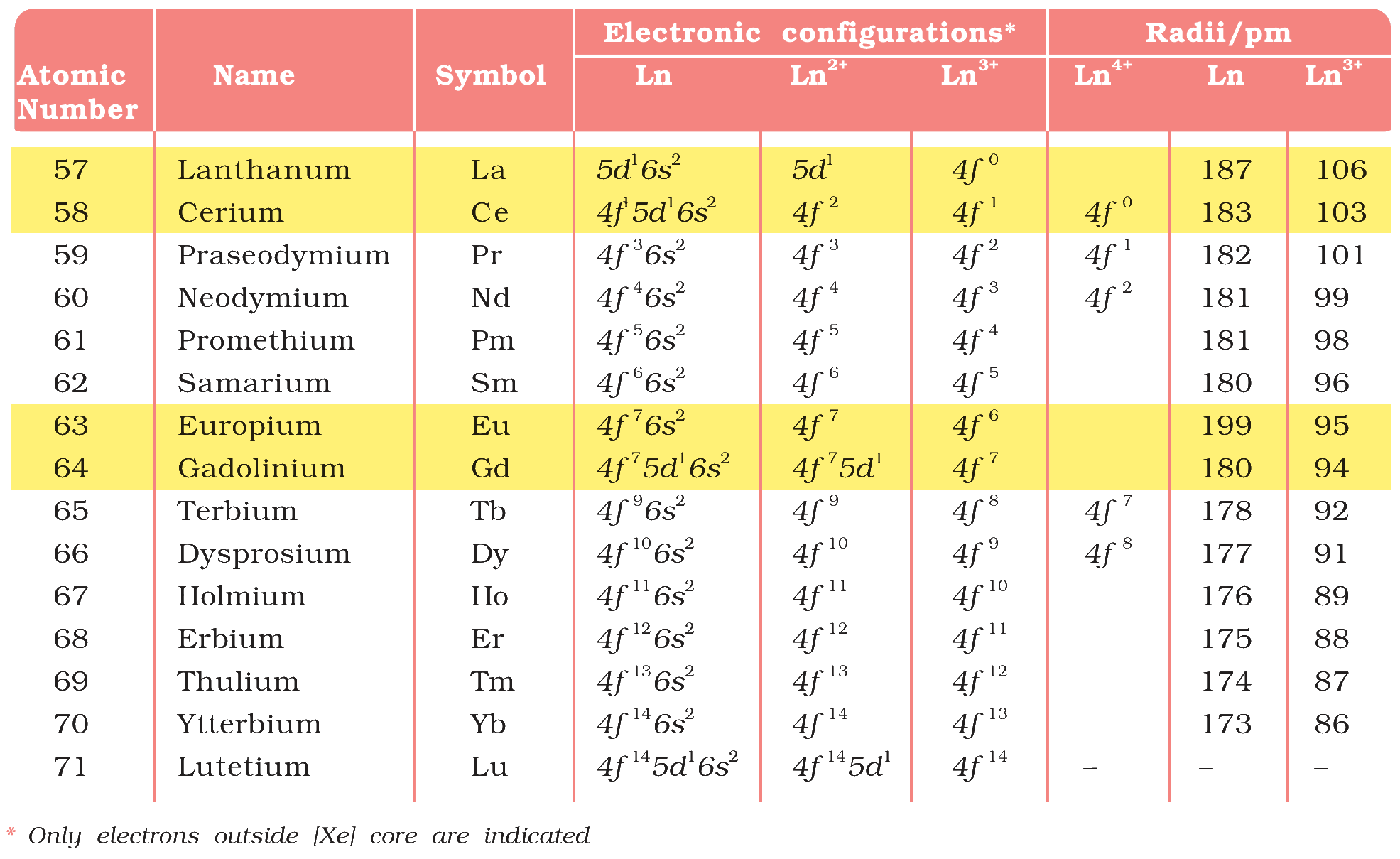
The f-block elements are those in which the differentiating electron enters the (n-2)f orbitals. There are two series of f-Block elements corresponding to filling of 4f and 5f-orbitals. The series of 4f-orbitals is called lanthanides. Lanthanides show different oxidation states depending upon stability of f0, f7 and f14 configurations, though the most common oxidation state is +3. There is a regular decrease in the size of lanthanide ions with increase in atomic number which is known as lanthanide contraction.
Which of the following lanthanides is well known to exhibit the +4 oxidation state?
Answer & explanation
Correct answer: option 1
The correct answer is Option (1) → Cerium (Z=58)
The common oxidation state of the lanthanides is +3. A +2 or +4 state appears when it gives the ion an empty (f0), half-filled (f7) or filled (f14) f subshell.
Configuration: Cerium (Z = 58) is [Xe]4f15d16s2.
Electrons removed: losing the two 6s electrons, the 5d electron and the single 4f electron gives \( \ce{Ce^4+} \): [Xe]4f0, the noble gas configuration.
So cerium is well known for the +4 state; Ce(IV) is a strong oxidant that reverts to the common +3 state.
Why the other options are incorrect
Option (2) Europium (Z=63) — Incorrect.
Configuration: Europium is [Xe]4f76s2.
Electrons removed: losing the two 6s electrons gives \( \ce{Eu^2+} \): 4f7, half-filled.
Result: europium is known for the +2 state (a strong reducing agent), not +4.
Option (3) Lanthanum (Z=57) — Incorrect.
Configuration: Lanthanum is [Xe]5d16s2.
Electrons removed: losing these three electrons already gives the noble gas core in \( \ce{La^3+} \) (4f0).
Result: a fourth electron would have to come from that stable core, so lanthanum shows no +4 state.
Option (4) Gadolinium (Z=64) — Incorrect.
Configuration: Gadolinium is [Xe]4f75d16s2.
Electrons removed: losing the 5d and two 6s electrons gives \( \ce{Gd^3+} \): 4f7, a half-filled subshell.
Result: +3 is its stable state; removing a fourth electron would break that half-filled set.
NCERT (2026-27 edition):
4.5.3 Oxidation States – “… However, occasionally +2 and +4 ions in solution or in solid compounds are also obtained. This irregularity (as in ionisation enthalpies) arises mainly from the extra stability of empty, half-filled or filled f subshell. Thus, the formation of CeIV is favoured by its noble gas configuration, but it is a strong oxidant reverting to the common +3 state.”
Table 4.9: Electronic Configurations and Radii of Lanthanum and Lanthanoids