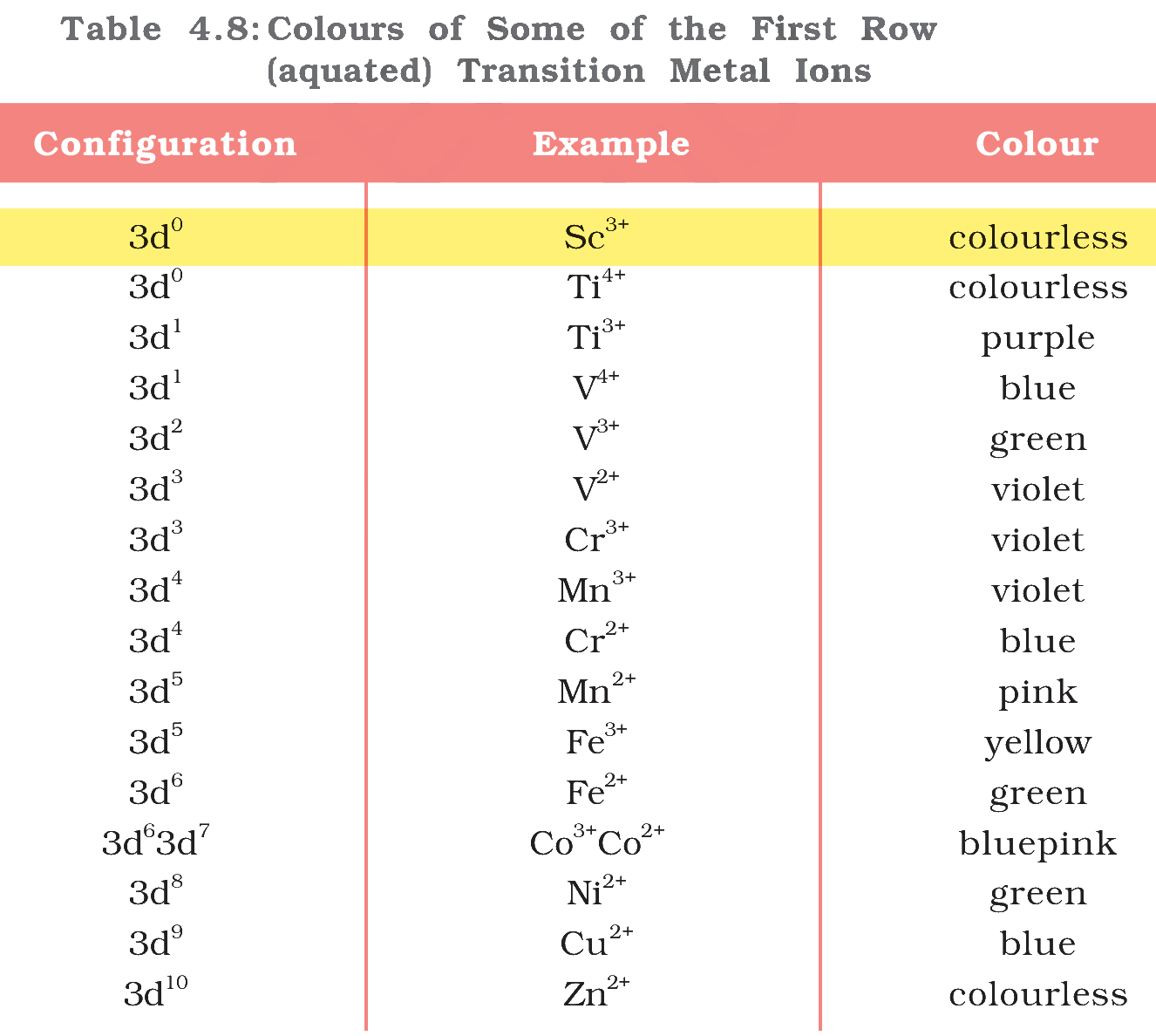
Which of the following is colourless?
Answer & explanation
Correct answer: option 4
The correct answer is Option (4) → [Sc(H2O)6]3+
The colour of a complex comes from a d–d transition: a d electron absorbs visible light and moves from the lower set of split d orbitals to the higher set. This needs at least one d electron and a vacant higher d orbital.
Oxidation state of Sc: in \( \ce{[Sc(H2O)6]^3+} \), water is neutral, so Sc is +3.
Configuration: Sc (Z = 21) is [Ar]3d14s2; losing all three outer electrons gives \( \ce{Sc^3+} \): 3d0.
d–d transition: with no d electron, none is possible, so no visible light is absorbed.
Result: the complex is colourless.
Why the other options are incorrect
Option (1) [Fe(H2O)6]3+ — Incorrect. \( \ce{Fe^3+} \) is 3d5; its d electrons can be excited to the higher d orbitals, so the aquated ion is coloured (yellow).
Option (2) [Fe(CN)6]3- — Incorrect. Here too iron is \( \ce{Fe^3+} \), 3d5. With the strong field CN– ligands the electrons sit as t2g5eg0, and the empty eg level allows a d–d transition, so the complex is coloured.
Option (3) [Ti(H2O)6]3+ — Incorrect. \( \ce{Ti^3+} \) is 3d1; the single electron is excited from t2g to eg by blue-green light, and the aquated ion is purple.
NCERT (2026-27 edition):
5.5.5 Colour in Coordination Compounds – “The colour in the coordination compounds can be readily explained in terms of the crystal field theory. … The crystal field theory attributes the colour of the coordination compounds to d-d transition of the electron.”
4.3.10 Formation of Coloured Ions