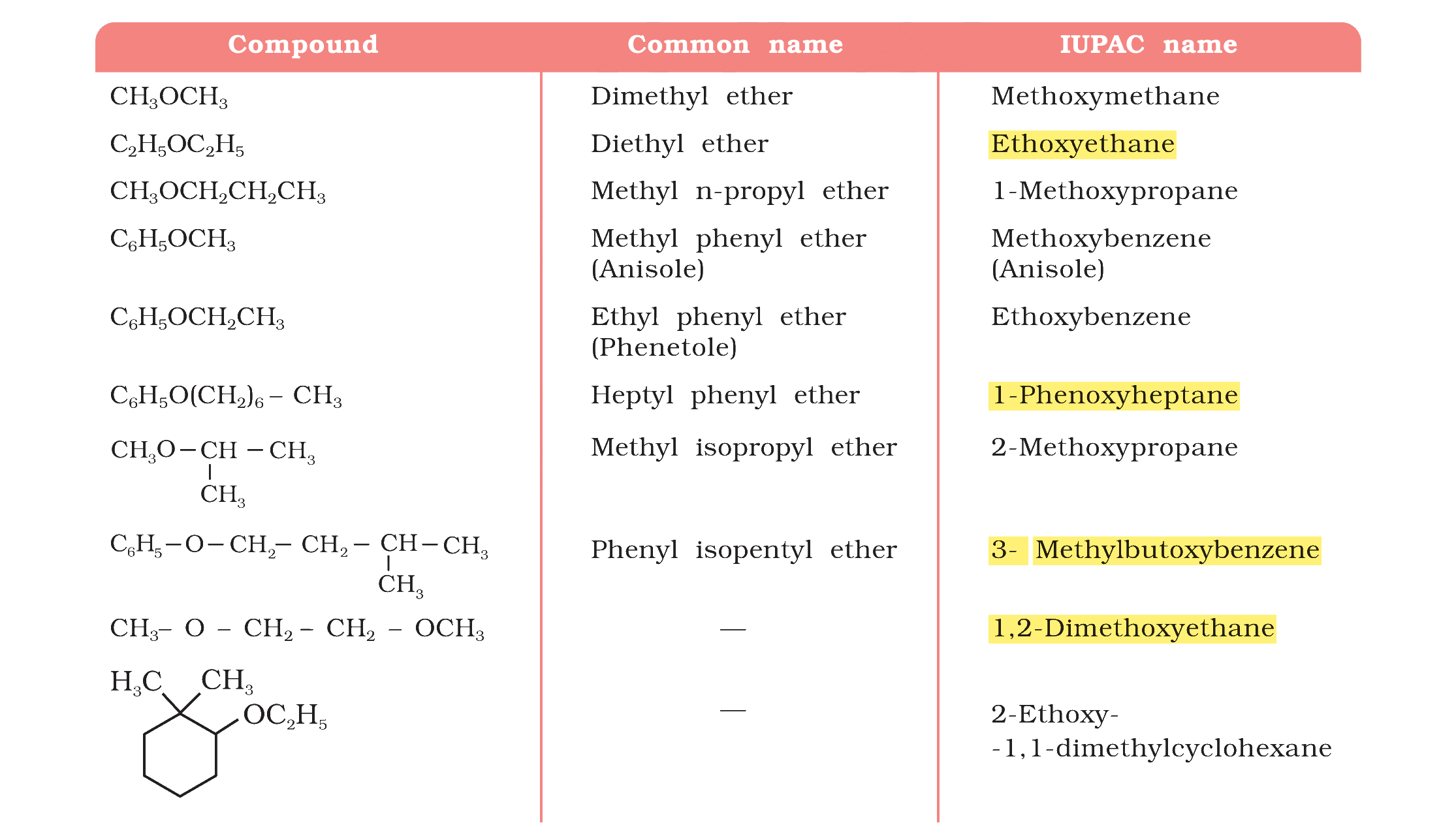
Match the ethers in List-I with their IUPAC names in List-II.
| List-I (Ether) | List-II (IUPAC name) |
|---|---|
| (A) C6H5O(CH2)6–CH3 | (I) 3-Methylbutoxybenzene |
| (B) C6H5–O–CH2–CH2–CH(CH3)–CH3 | (II) Ethoxyethane |
| (C) CH3–O–CH2–CH2–OCH3 | (III) 1-Phenoxyheptane |
| (D) C2H5OC2H5 | (IV) 1,2-Dimethoxyethane |
Choose the correct answer from the options given below:
Answer & explanation
Correct answer: option 3
The correct answer is Option (3) → A-III, B-I, C-IV, D-II
In the IUPAC system an ether is named as a hydrocarbon in which a hydrogen atom is replaced by an –OR or –OAr group. The larger group is chosen as the parent hydrocarbon and the other group, with the oxygen, becomes the alkoxy or phenoxy prefix.
(A) C6H5O(CH2)6–CH3 — This matches (III) 1-Phenoxyheptane. The heptyl chain (seven carbons) is larger than the phenyl group (six carbons), so heptane is the parent and C6H5O– is the phenoxy group on C-1.
(B) C6H5–O–CH2–CH2–CH(CH3)–CH3 — This matches (I) 3-Methylbutoxybenzene. The alkyl group (isopentyl) has five carbons, fewer than the ring, so benzene is the parent. Numbered from the carbon joined to oxygen, the alkoxy group is a butoxy chain with a methyl group on C-3.
(C) CH3–O–CH2–CH2–OCH3 — This matches (IV) 1,2-Dimethoxyethane. The two-carbon chain between the oxygen atoms is the parent, ethane, and it carries two methoxy groups, one on each carbon.
(D) C2H5OC2H5 — This matches (II) Ethoxyethane. Both groups are ethyl; one ethyl group is the parent ethane and the other, with the oxygen, is the ethoxy group (common name diethyl ether).
NCERT (2026-27 edition):
7.2 Nomenclature – “According to IUPAC system of nomenclature, ethers are regarded as hydrocarbon derivatives in which a hydrogen atom is replaced by an –OR or –OAr group, where R and Ar represent alkyl and aryl groups, respectively. The larger (R) group is chosen as the parent hydrocarbon. The names of a few ethers are given as examples in Table 7.2.”
Table 7.2: Common and IUPAC Names of Some Ethers