
Match List I with List II
| List I | List II |
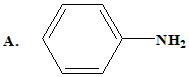 |
I. Hoffmann Bromamide degradation reaction |
| B. \(CH_3NH_2\) | II. Azo dye formation |
| C. \(CH_3CH_2CONH_2\) | III. Gabriel phthalimide synthesis |
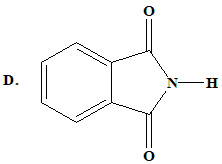 |
IV. Carbylamine reaction |
Choose the correct answers from the options given below:
Answer & explanation
Correct answer: option 2
The correct answer is Option (2) → A-II, B-IV, C-I, D-III
Each compound in List I is matched by the reaction it typically undergoes or the preparation it is used in: aromatic primary amines form diazonium salts and azo dyes, primary amines give the carbylamine test, amides undergo Hofmann degradation, and phthalimide is the starting material of the Gabriel synthesis.
A. Aniline (structure A) — This matches II. Azo dye formation. Aniline is diazotised with \( \ce{NaNO2} \)/HCl at 273–278 K, and the benzenediazonium chloride couples with phenol (or another arylamine) to give an azo dye.
\( \displaystyle \ce{C6H5NH2 + NaNO2 + 2HCl} \xrightarrow{\text{273-278 K}} \ce{C6H5N2^+Cl^- + NaCl + 2H2O} \)
\( \displaystyle \ce{C6H5N2^+Cl^- + C6H5OH} \xrightarrow{\ce{OH^-}} \ce{C6H5-N=N-C6H4OH + HCl} \) (p-hydroxyazobenzene, orange)
B. CH3NH2 — This matches IV. Carbylamine reaction. Methylamine is a primary amine and gives methyl isocyanide with chloroform and alcoholic KOH. (Aliphatic diazonium salts are unstable, so it cannot give an azo dye.)
\( \displaystyle \ce{CH3NH2 + CHCl3 + 3KOH} \xrightarrow{\Delta} \ce{CH3NC + 3KCl + 3H2O} \)
C. CH3CH2CONH2 — This matches I. Hoffmann Bromamide degradation reaction. Propanamide with \( \ce{Br2} \) and NaOH gives ethanamine, with one carbon atom less.
\( \ce{CH3CH2CONH2 + Br2 + 4NaOH -> CH3CH2NH2 + Na2CO3 + 2NaBr + 2H2O} \)
D. Phthalimide (structure D) — This matches III. Gabriel phthalimide synthesis. Phthalimide with ethanolic KOH gives potassium phthalimide, which with an alkyl halide and then alkaline hydrolysis gives a primary amine.
\( \displaystyle \ce{C6H4(CO)2NH} \xrightarrow{\ce{KOH}\text{ (alc.)}} \ce{C6H4(CO)2N^-K^+} \xrightarrow{\ce{R-X}} \ce{C6H4(CO)2N-R} \xrightarrow{\ce{NaOH}\text{ (aq)}} \ce{R-NH2} \)
Shortcut: C-I (the amide undergoes Hofmann degradation) appears only in Option (2).