Read the passage given below and answer the following question.

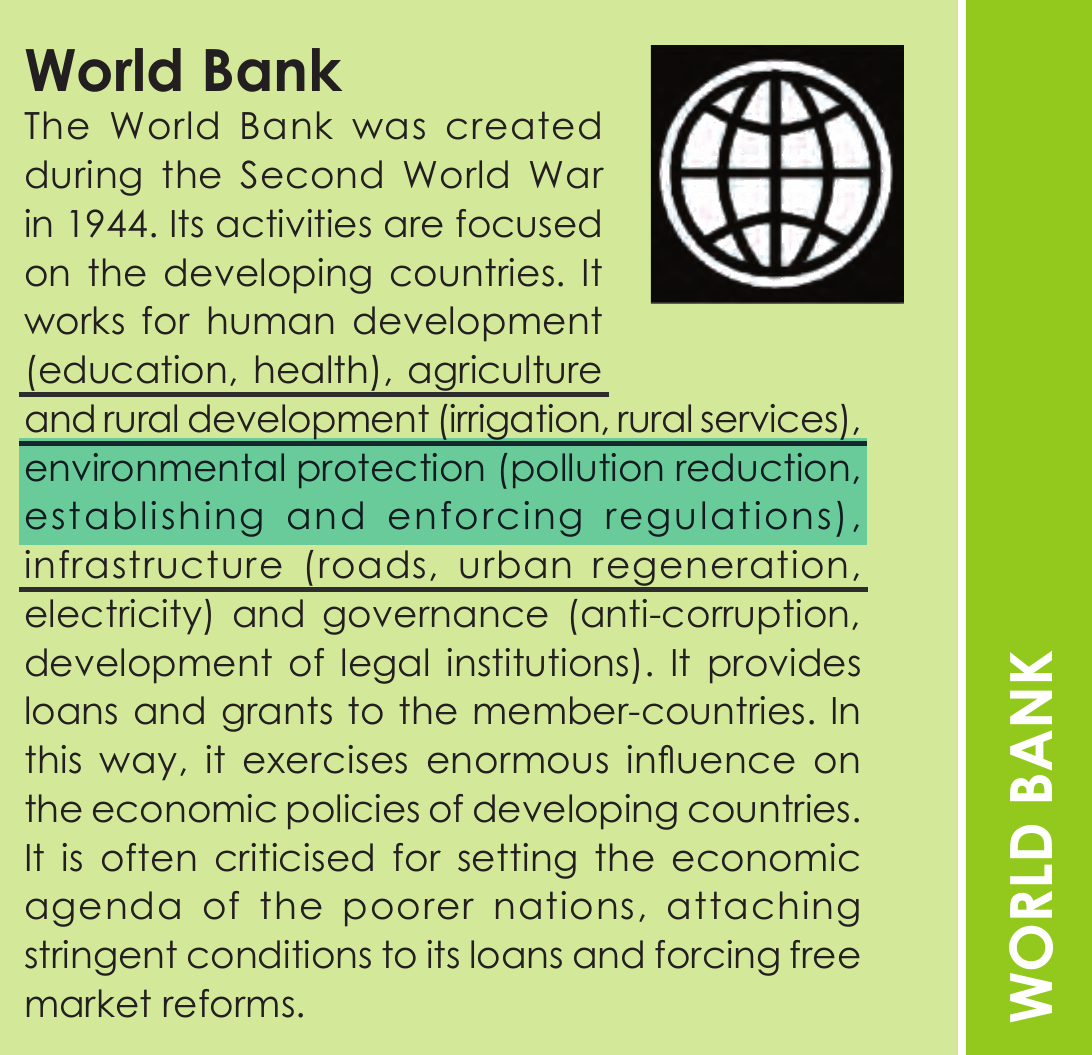
The World Bank was created during the Second World War in 1944. Its activities are focused on the developing countries. It works for human development (education, health), agriculture and rural development (irrigation, rural services), environment protection (pollution reduction, establishing and enforcing regulation), infrastructure (roads, urban regeneration, electricity) and governance (anti-corruption, development of legal institutions). It provides loans and grants to the member-countries. In this way, it exercises enormous influence on the economic policies of developing countries. It is often criticised for setting the economic agenda of the poorer nations, attaching stringent conditions to its loans and forcing free market reforms.
Identify the incorrect statement regarding the grants given by World Bank for development.
Answer & explanation
Correct answer: option 2
The correct answer is Option (2) → Environment Pollution
Option (1) Health and Education — True. The World Bank works for human development, that is, education and health.
Option (2) Environment Pollution — False. The World Bank works for environmental protection: pollution reduction and establishing and enforcing regulations. Its grants go to reducing pollution, so ‘environment pollution’ is not one of its areas of work.
Option (3) Irrigation and Rural services — True. It works for agriculture and rural development, that is, irrigation and rural services.
Option (4) Roads and Urban regeneration — True. It works for infrastructure: roads, urban regeneration and electricity.
Note: The passage of Q1 to Q5 is taken from the NCERT box ‘World Bank’ of the chapter ‘International Organisations’. A box of about a dozen lines gave five questions here, so the boxes of the book deserve a line-by-line reading.
NCERT (2026-27): Contemporary World Politics — Chapter 4: International Organisations
World Bank box (2026-27): environmental protection (pollution reduction, establishing and enforcing regulations) |