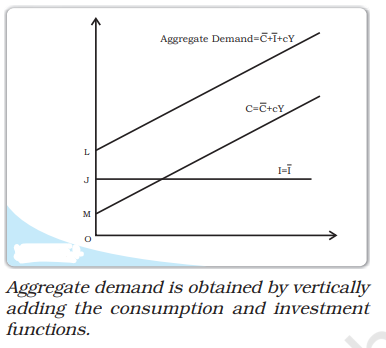
In graphical representation, how is the aggregate demand function obtained?
Answer & explanation
Correct answer: option 1
The correct answer is Option (1) → By adding the consumption and investment functions vertically.
In a simple two-sector (household and firm) Keynesian model of income determination, aggregate demand (AD) is the sum of consumption expenditure (C) and investment expenditure (I).
-
Consumption Function (C): This shows the relationship between disposable income and consumption spending. Graphically, it's typically an upward-sloping line.
Investment Function (I): In this simplified model, investment is often assumed to be autonomous, meaning it does not depend on the level of income. Graphically, it would be a horizontal line.
-
The Aggregate Demand function shows the total demand (made up of consumption + investment) at each level of income. Graphically it means the aggregate demand function can be obtained by vertically adding the consumption and investment function.
Here, OM = $\bar C$
OJ = $\bar I$
OL = $\bar C$ + $\bar I$
The aggregate demand function is parallel to the consumption function i.e., they have the same slope c.