CUETMOCK
  • Pricing
  • Mentors
Log inStart freeStart free mocks→

First test, then trust

Try a free CUET mock test.

Join 5,00,000+ students who rehearsed exam day on the exact NTA screen before sitting CUET. On the web and on Android.

Start free mocks →Get the Android app
CUETMOCK

India's #1 CUET Mock Test Platform. Original NCERT-based questions on the exact NTA exam screen — trusted by 5,00,000+ students since CUET 2022.

Get it onGoogle PlayScan to download the CUETMOCK app

Mock tests

  • CUET mock test series
  • Browse all papers
  • Commerce mocks
  • Humanities (Arts) mocks
  • Science mocks
  • Languages & GAT mocks
  • Free practice questions
  • Pricing

Resources

  • CUET exam guide
  • CUET syllabus
  • Universities accepting CUET
  • Expert blogs
  • News & notifications
  • Webinars & counselling
  • CUET score calculator
  • How we estimate your rank
  • FAQs

Company

  • About us
  • Our leadership & team
  • Our toppers
  • Mentors
  • For schools
  • Contact us
  • Terms
  • Privacy
  • Refund policy

Talk to us

+91 7696 6630 56info@cuetmock.comWhatsApp us

Our other platforms

  • JEE Mock — For IIT-JEE aspirants
  • NEET Mock — For NEET aspirants

Newsletter

Exam updates, study material and offers — no spam.

© 2026 NYC Ventures Pvt. Ltd.

701-702, Royal Business Park, Zirakpur, Punjab - 140603

  • Terms of use
  • Privacy policy
  • Refund policy
  • Contact us

iCUETMOCK is an independent preparation platform, not affiliated with the National Testing Agency (NTA). Always check exam details on the official NTA website.

  • Home
  • Mock tests
  • CUET guide
  • Pricing
  • Log in
Home/Practice questions/General Aptitude Test
General Aptitude TestVerbal ReasoningSyllogism

Three statements are given, followed by three conclusions numbered I,…

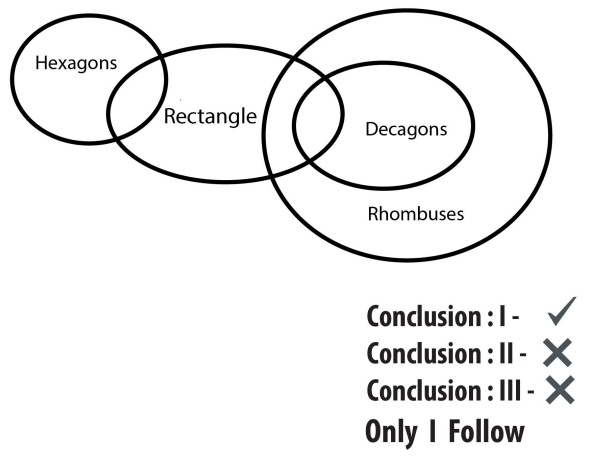
Three statements are given, followed by three conclusions numbered I, II and III. Assuming the statements to be true, even if they seem to be at variance with commonly known facts, decide which of the conclusions logically follow(s) from the statements.

Statements:

Some hexagons are rectangles.

Some rectangles are decagons.

All decagons are rhombuses.

Conclusions:

I. Some rhombuses are rectangles.

II. Some rhombuses are hexagons.

III. Some decagons are hexagons.

Answer & explanation+

Correct answer: option 2

Advertisement

Practise more on Verbal Reasoning

Chapter-wise mocks on the real NTA exam screen, with solutions and your rank. Your first mocks are free.

Start free mocks →

Advertisement

Next questions

  1. ∫ 5^5^5^x.5^5^x.5^x dx is equal to:Maths. Section A · Indefinite Integration
  2. North-East region consists of seven States called _____.Political Science · Politics in India Since Independence: Regional Aspirations
  3. Which of the following makes GDP an inappropriate index of welfare?(A) Distribution of GDP.(B) Externalities.(C) Non-monetary exchanges.(D)…Economics · Macro Economics: National Income Accounting
  4. An estimate of the funds needed for promotion, advertising and public relations is called as _______.Entrepreneurship · Entrepreneurial Opportunity
  5. Statement I: The Fe2+ ion is more stable than the Fe3+ ion.Statement II: The Fe3+ ion has a half-filled 3d subshell.Chemistry · Inorganic: D and F Block Elements
  6. Match List I with List II List I List II A. Artificial sweetener I. Furacine B. Antihistamines II. Non-narcotic C. Aspirin III. Alitame D.…Chemistry · Organic: Chemistry in Everyday Life
  7. When certain exotic species are introduced into a new geographical area, they often become invasive and spread fast. Which of the following…Biology · Organisms and Populations
  8. Economists define an unemployed person in a particular way. Who among the following would they call unemployed?Economics · Indian Economic Development: Employment - Growth, Informalisation and Other Issues
  9. The rms current in a series LCR circuit is I . The average power dissipated in the circuit isPhysics · Alternating Current
  10. Area of the region bounded by curve y^2 = 4x and the X-axis between x = 0 and x = 1 isMaths. Section B1 · Application of Integrals