Read the passage and answer the questions:
Why was salt the symbol of protest? This is what Mahatma Gandhi wrote:
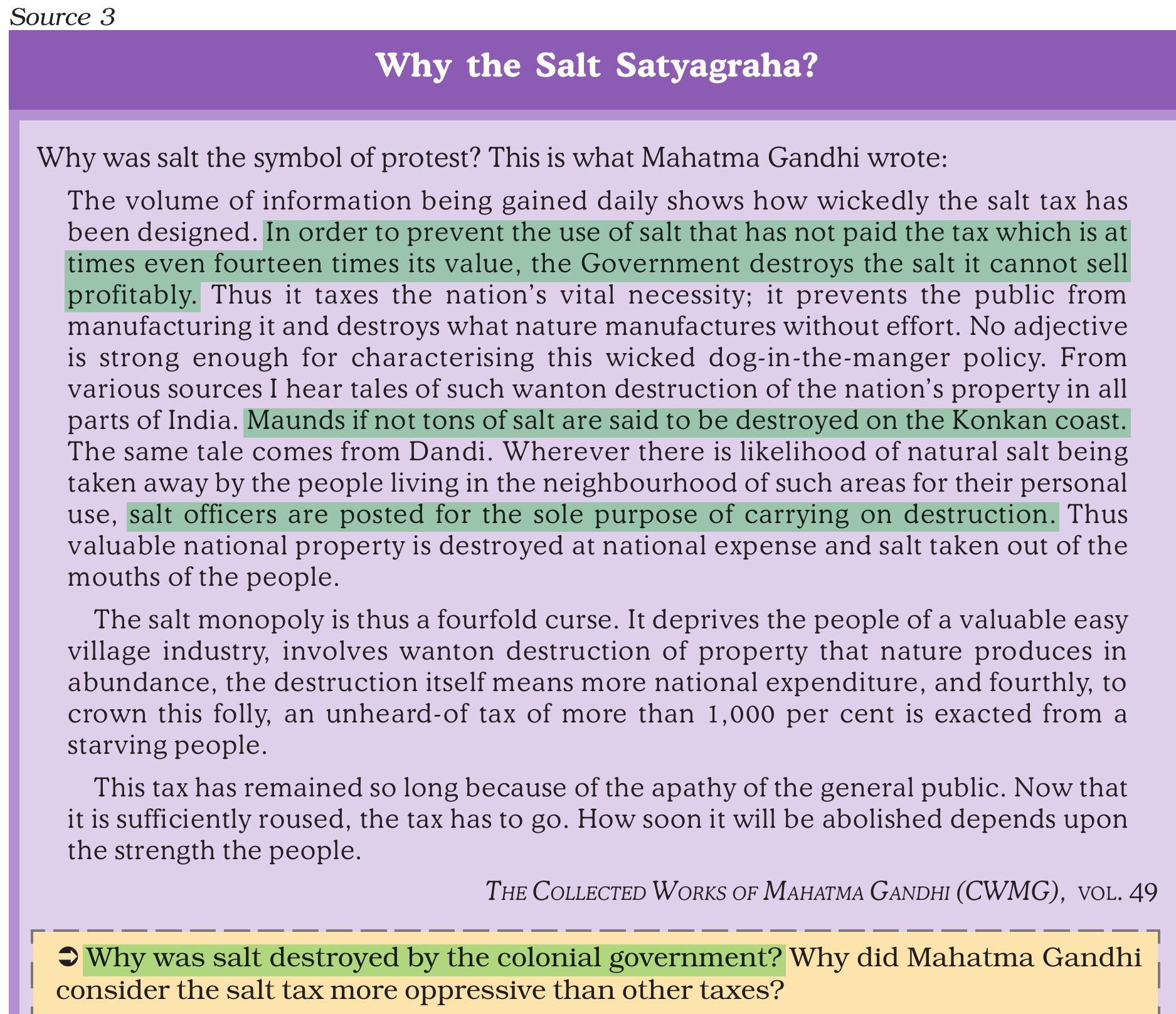
The volume of information being gained daily shows how wickedly the salt tax has been designed. In order to prevent the use of salt that has not paid the tax which is at times even fourteen times its value, the Government destroys the salt it cannot sell profitably. Thus it taxes the nation's vital necessity; it prevents the public from manufacturing it and destroys what nature manufactures without effort. No adjective is strong enough for characterising this wicked dog-in-the-manger policy. From various sources I hear tales of such wanton destruction of the nation's property in all parts of India. Maunds if not tons of salt are said to be destroyed on the Konkan coast. The same tale comes from Dandi. Wherever there is likelihood of natural salt being taken away by the people living in the neighborhood of such areas for their personal use, salt officers are posted for the sole purpose of carrying on destruction. Thus valuable national property is destroyed at national expense and salt taken out of the mouths of the people. The salt monopoly is thus a fourfold curse. It deprives the people of a valuable easy village industry, involves wanton destruction of property that nature produces in abundance, the destruction itself means more national expenditure, and fourthly, to crown this folly, an unheard-of tax of more than 1,000 percent is exacted from a starving people.
This tax has remained so long because of the apathy of the general public. Now that it is sufficiently roused, the tax has to go. How soon it will be abolished depends upon the strength of the people.
Why were maunds of salt destroyed by the salt officials?
Answer & explanation
Correct answer: option 2
The correct answer is Option (2) → To earn maximum profit.
Gandhi gives the reason in the passage: to prevent the use of salt that has not paid the tax, the Government destroys the salt it cannot sell profitably. Wherever people might take away natural salt for their own use, salt officers are posted only to destroy it.
Option (1) Shortage of salt. — Incorrect. There was no shortage. Nature produced salt in abundance, and the officials destroyed the salt that could not be sold.
Option (2) To earn maximum profit. — Correct. Salt that could not be sold at a profit, or that people could collect without paying the tax, was destroyed, so that only taxed salt reached the people and the government’s income from salt stayed high.
Option (3) To destroy natural resource. — Incorrect. Destruction was the means, not the aim. Gandhi’s complaint is that the government destroys what nature manufactures only to protect its salt revenue.
Option (4) To repress nationalist movement. — Incorrect. The passage ties the destruction to the salt tax and its profits; the nationalist movement does not come into it.
NCERT: Themes in Indian History Part III — Chapter 11: Mahatma Gandhi and the Nationalist Movement (2026-27)
|