Which of the following statements is correct?
Answer & explanation
Correct answer: option 3
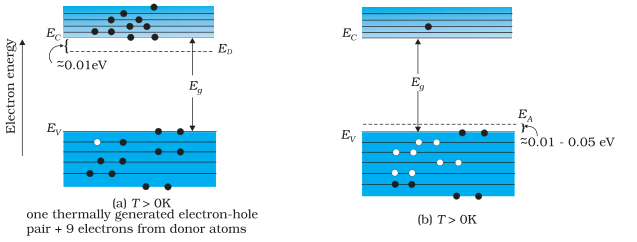
The correct answer is Option (3) → In n-type semiconductor, the energy levels of the donor atom are close to the conduction band.
Doping adds new energy levels inside the band gap: donor levels lie just below the conduction band (n-type) and acceptor levels lie just above the valence band (p-type).
Option (1) In a p-type semiconductor, acceptor energy levels are close to conduction band. — Incorrect. Acceptor levels lie close to the valence band, so electrons from the valence band can easily move into them.
Option (2) In a p-type semiconductor, electrons are the majority of carriers. — Incorrect. In a p-type semiconductor the majority carriers are holes; electrons are the minority carriers.
Option (3) In n-type semiconductor, the energy levels of the donor atom are close to the conduction band. — Correct. The donor level is only about 0.01–0.05 eV below the conduction band, so its extra electron is easily excited into the conduction band.
Option (4) A p-type semiconductor can be formed by doping an intrinsic semiconductor with Arsenic atoms. — Incorrect. Arsenic is pentavalent and gives an n-type semiconductor; a p-type semiconductor needs a trivalent dopant such as boron, aluminium or indium.
NCERT (2026-27):
Extrinsic Semiconductor – “… In the energy band diagram of n-type Si semiconductor, the donor energy level \( E_D \) is slightly below the bottom \( E_C \) of the conduction band and electrons from this level move into the conduction band with very small supply of energy. … Similarly, for p-type semiconductor, the acceptor energy level \( E_A \) is slightly above the top \( E_V \) of the valence band as shown in Fig. 14.9(b).”