
A company has two factories located at P and Q and has three depots situated at A, B and C. The weekly requirement of the depots at A, B and C is respectively 5, 5 and 4 units, while the production capacity of the factories at P and Q are respectively 8 and 6 units. The cost (in) of transportation per unit is given below.
|
Cost (in ) |
|||
|
To → From ↓ |
A |
B |
C |
|
P |
160 |
100 |
150 |
|
Q |
100 |
120 |
100 |
How many units should be transported from each factory to each depot in order that the transportation cost is minimum?
Answer & explanation
Correct answer: option 2
The correct answer is Option (2) → ₹1550
We note that total weekly production (of P and Q) = 8+ 6 = 14 units, and total weekly requirement at depots A, B, C = 5 + 5 + 4 = 14 units, so there is no mismatch between supply and demand.
Let factory P supply x units per week to depot A and y units to depot B so that it supplies $8 - x - y$ units to depot C. Obviously $0 ≤ x ≤ 5, 0 ≤ y ≤ 5, 0 ≤8-x - y ≤ 4$.
The given data can be represented diagrammatically as:
As depot A's requirement is 5 units and it receives x units from factory P, it must receive $(5 - x)$ units from factory Q. Similarly, depot B receives $(5 - y)$ units from factory Q and Depot C receives $4- (8-x − y) = x + y - 4$ units from factory Q.
(As a cross-check, quantity supplied from factory Q to depots $A, B, C =(5x) + (5− y) + (x + y − 4) = 6$ units = capacity of factory Q.)
The total transportation cost (in ₹)
$= 160x + 100y+ 150(8 - x - y) + 100(5-x) + 120(5− y) + 100(x + y − 4)$
$= 10(x - 7y+ 190)$.
Hence, the given problem can be formulated as an L.P.P. as :
Find x and y which minimize
$Z = 10(x-7y+ 190)$ subject to the constraints
$x + y ≥ 4, x + y ≤ 8, x 20, x ≤5, y ≥0, y ≤5$
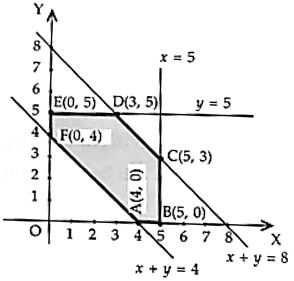
The feasible region corresponding to these inequalities is shown shaded in the figure given below. It is the bounded (convex) region ABCDEF. We calculate the values of Z (in ₹) at the six corner points:
|
Point |
$x$ |
$y$ |
$Z=10 (x-7y+190)$ |
|
A |
4 |
0 |
1940 |
|
B |
5 |
0 |
1950 |
|
C |
5 |
3 |
1740 |
|
D |
3 |
5 |
1580 |
|
E |
0 |
5 |
1550 → Minimum |
|
F |
0 |
4 |
1620 |
We see that Z is minimum ₹1550 at point E(0, 5). Hence, $x = 0, y = 5$. Thus, for minimum transportation cost, factory P should supply 0, 5, 3 units to depots A, B, C respectively and factory Q should supply 5, 0, 1 units respectively to depots A, B, C.