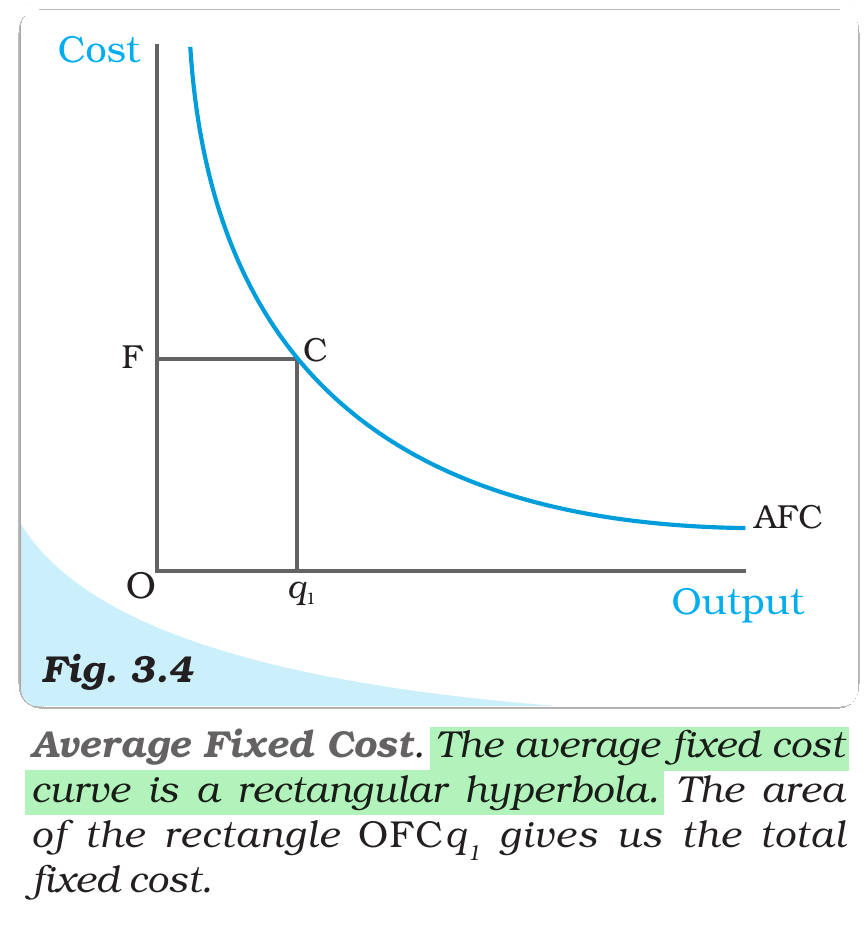
Average Fixed Cost (AFC) is indicated by?
Answer & explanation
Correct answer: option 1
The correct answer is Option (1) → A rectangular hyperbola.
Average fixed cost (AFC) is total fixed cost (TFC) divided by output (q). TFC does not change with output, so AFC keeps falling as output rises. If we multiply any output by its AFC, we always get the same constant, TFC. A curve with this property is a rectangular hyperbola.
Option (1) A rectangular hyperbola. — Correct. AFC × q is always equal to TFC. AFC is very large near zero output and moves towards zero as output grows.
Option (2) A straight line parallel to X axis. — Incorrect. This is the shape of the TFC curve, because total fixed cost stays the same at every output. The average falls as output grows.
Option (3) A straight line parallel to Y axis. — Incorrect. A vertical line would show many costs at one output. On a cost curve, output changes along the X axis.
Option (4) A U-shaped curve. — Incorrect. AFC keeps falling as output rises, so it has no rising part. The U-shape belongs to average variable cost, short run average cost and short run marginal cost.
Note: A same/similar question was asked in CUET (UG) in the papers below.
| 2026 | 2025 | 2024 | 2023 | 2022 |
| – | 13-05 S1* 27-05 S2* 29-05 S2* 02-06 S1 03-06 S2* | – | – | – |
* A similar question.
NCERT (2026-27): “Shapes of the Short Run Cost Curves …TFC is a constant which takes the value c1 and does not change with the change in output. It is, therefore, a horizontal straight line cutting the cost axis at the point c1.… AFC is the ratio of TFC to q. TFC is a constant. Therefore, as q increases, AFC decreases. When output is very close to zero, AFC is arbitrarily large, and as output moves towards infinity, AFC moves towards zero. AFC curve is, in fact, a rectangular hyperbola. If we multiply any value q of output with its corresponding AFC, we always get a constant, namely TFC.”
|