Which two stable ions of the first transition series have the largest number of unpaired electrons and hence the highest magnetic moment?
Answer & explanation
Correct answer: option 3
The correct answer is Option (3) → Fe3+ and Mn2+
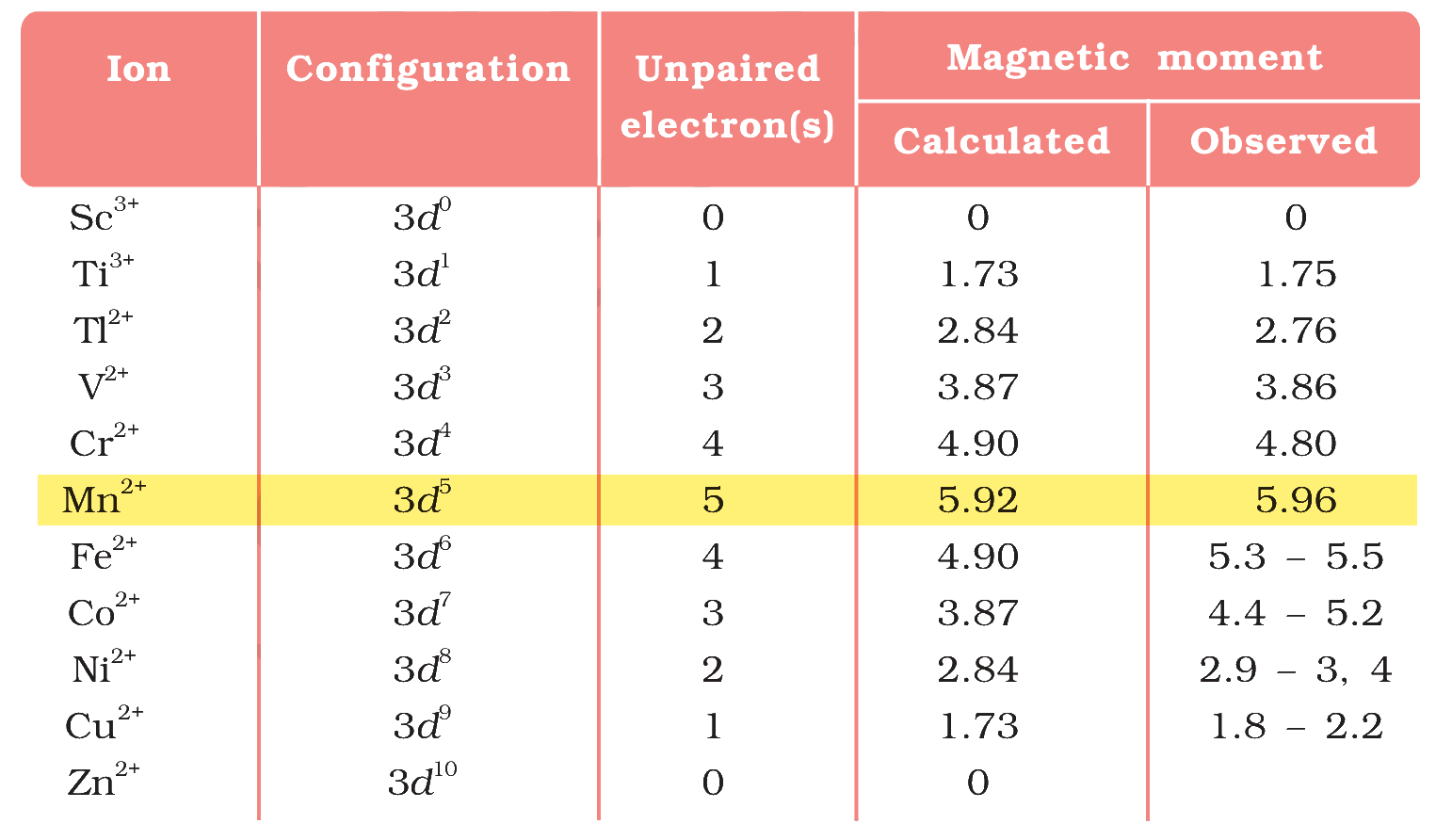
The magnetic moment rises with the number of unpaired electrons, \( \mu=\sqrt{n(n+2)} \) BM. In the five 3d orbitals the electrons go in singly first, so the largest number of unpaired electrons, five, belongs to a 3d5 ion. The 4s electrons are lost first when the ion forms.
\( \ce{Fe^3+} \) (Z = 26, [Ar]3d64s2 minus three electrons) is 3d5, 5 unpaired; \( \ce{Mn^2+} \) (Z = 25, [Ar]3d54s2 minus two electrons) is 3d5, 5 unpaired. Only Fe3+ and Mn2+ both have five unpaired electrons.
Magnetic moment of a d5 ion: \( \mu=\sqrt{5(5+2)}=\sqrt{35}=5.92 \) BM, the highest value in the series.
Why the other options are incorrect
Option (1) Ni2+ and Co2+ — Incorrect. \( \ce{Ni^2+} \) (Z = 28) is 3d8, 2 unpaired; \( \ce{Co^2+} \) (Z = 27) is 3d7, 3 unpaired.
Option (2) Cr2+ and Fe2+ — Incorrect. \( \ce{Cr^2+} \) (Z = 24) is 3d4, 4 unpaired; \( \ce{Fe^2+} \) (Z = 26) is 3d6, 4 unpaired.
Option (4) Ti4+ and Mn2+ — Incorrect. \( \ce{Ti^4+} \) (Z = 22) is 3d0, 0 unpaired; \( \ce{Mn^2+} \) is 3d5, 5 unpaired.
NCERT (2026-27 edition):
4.3.3 Ionisation Enthalpies – “… However, the trend of steady increase in second and third ionisation enthalpy breaks for the formation of Mn2+ and Fe3+ respectively. In both the cases, ions have d5 configuration.”
4.3.9 Magnetic Properties – “The magnetic moment increases with the increasing number of unpaired electrons. … The magnetic moments calculated from the ‘spin-only’ formula and those derived experimentally for some ions of the first row transition elements are given in Table 4.7.”
Table 4.7: Calculated and Observed Magnetic Moments (BM)