
A class visits a museum gallery on the Harappan civilisation. The first case holds a small terracotta animal figure beside charred grains from Harappan sites. The second case holds two seals found in distant lands: one is a cylinder seal of a type common in Mesopotamia, the other was found at a distant coastal site. A third panel quotes an ancient Mesopotamian myth that speaks of a bird from Meluhha, a land that may have been the Harappan region. The guide reminds the students that each object is a clue that archaeologists must interpret with care.
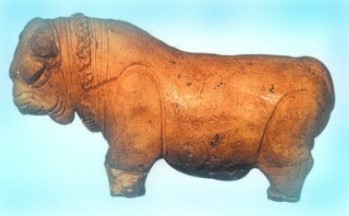
The terracotta figure in the first case is shown. What have archaeologists extrapolated from such representations on seals and terracotta sculpture?
Answer & explanation
Correct answer: option 1
The correct answer is Option (1) → Oxen were used for ploughing
Seals and terracotta sculpture show that the bull was known, and from this archaeologists infer that oxen were used for ploughing.
NCERT (2026-27): “2.1 Agricultural technologies … “Archaeologists have also found evidence of a ploughed field at Kalibangan (Rajasthan), associated with Early Harappan levels (see p. 20). The field had two sets of furrows at right angles to each other, suggesting that two different crops were grown together.” |