Suppose the Income of consumers in a market increases. How will this affect the equilibrium price of the commodity, assuming that it is a normal good?
(A) There is excess demand at the existing price.
(B) Rising price leads to contraction in demand and expansion in supply and a new equilibrium price is attained, which is higher than the initial price.
(C) The demand curve shifts rightward.
(D) There is upward pressure on the price and price starts rising.
Choose the correct answer from the options given below:
Answer & explanation
Correct answer: option 2
The correct answer is Option (2) → (C), (A), (B), (D)
Note: The given answer, Option (2), is as per the official NTA Answer Key. However, this answer appears to be wrong. As per the NCERT book, the correct answer should be Option (3) → (C), (A), (D), (B), as explained below.
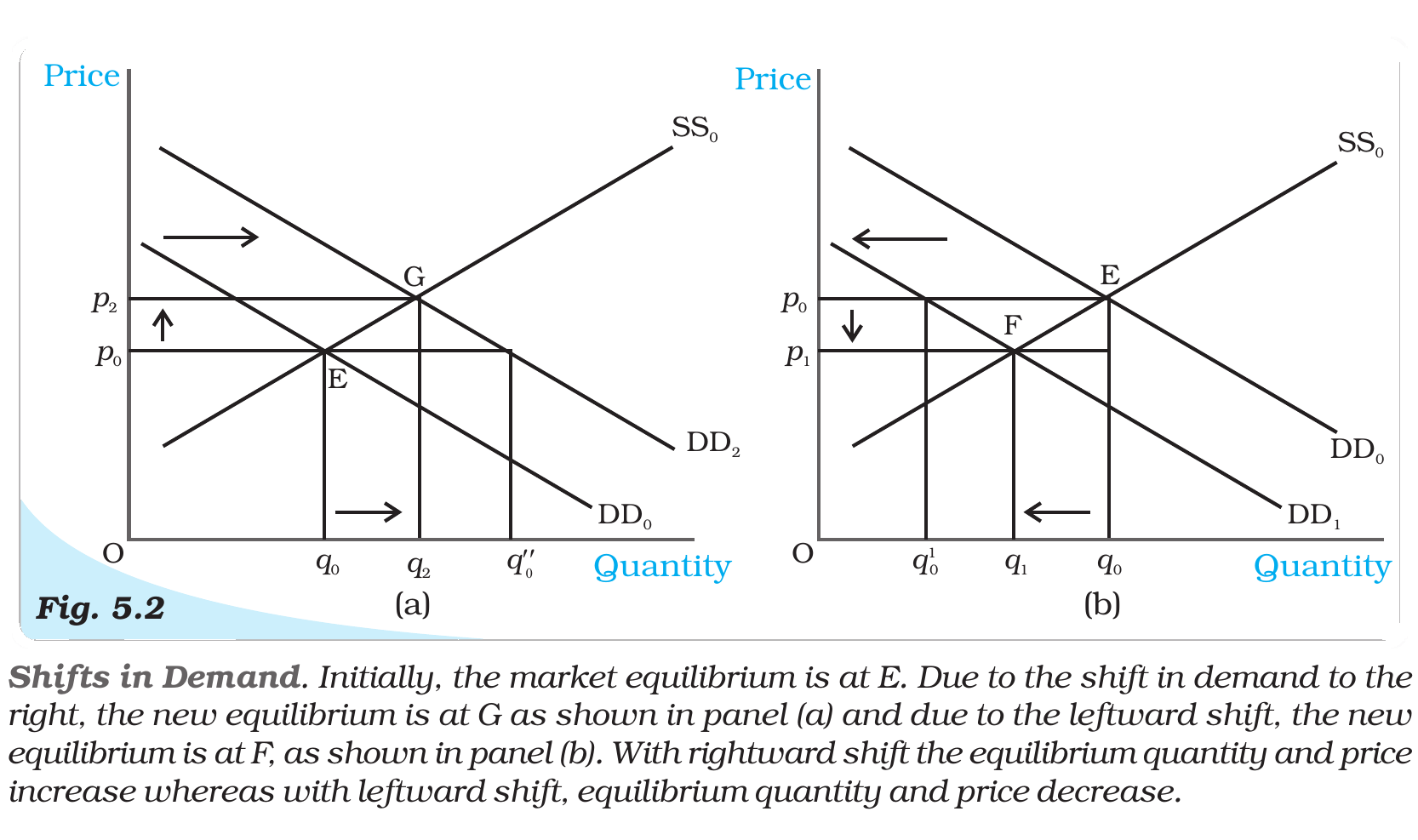
A market is in equilibrium when quantity demanded equals quantity supplied. For a normal good, demand rises when income rises. Supply does not change, because it depends on the firms’ costs, not on buyers’ income. The market then reaches a new equilibrium in these steps, each caused by the one before:
(C) The demand curve shifts rightward. — The rise in income comes first. At every price buyers now want more than before, so the demand curve moves right.
(A) There is excess demand at the existing price. — At the old price, firms still offer the old quantity, but buyers want more. This is excess demand, caused by the shift in (C).
(D) There is upward pressure on the price and price starts rising. — Buyers who cannot get enough are willing to pay a higher price, so the price rises.
(B) Rising price leads to contraction in demand and expansion in supply and a new equilibrium price is attained, which is higher than the initial price. — As the price rises, buyers buy less (contraction in demand) and firms offer more (expansion in supply). The price stops rising at a new equilibrium with a higher price and a larger quantity. This step is caused by the rising price, so it must come after (D).
Advice for the exam: In the real exam, mark the answer that is correct as per the NCERT book. If NTA’s provisional answer key marks a different option, challenge it during the answer-key challenge window, giving proper reasoning. NTA does revise its key when a challenge is well justified, so a sound challenge can raise your marks.
NCERT (2026-27): “Demand Shift … Now suppose the market demand curve shifts rightward to DD2 with supply curve remaining unchanged at SS0, as shown in panel (a). This shift indicates that at any price the quantity demanded is more than before. Therefore, at price p0 now there is excess demand in the market equal to q0q′′0 . In response to this excess demand some individuals will be willing to pay higher price and the price would tend to rise. The new equilibrium is attained at G where the equilibrium quantity q2 is greater than q0 and the equilibrium price p2 is greater than p0.… Suppose due to a hike in the salaries of the consumers, their incomes increase. How would it affect equilibrium? With an increase in income, consumers are able to spend more money on some goods. But recall from Chapter 2 that the consumers will spend less on an inferior good with increase in income whereas for a normal good, with prices of all commodities and tastes and preferences of the consumers held constant, we would expect the demand for the good to increase at each price as a result of which the market demand curve will shift rightward. … However, this income increase does not have any impact on the supply curve, which shifts only due to some changes in the factors relating to technology or cost of production of the firms. Thus, the supply curve remains unchanged.…”
|