What do you mean by res communis humanitatis?
Answer & explanation
Correct answer: option 4
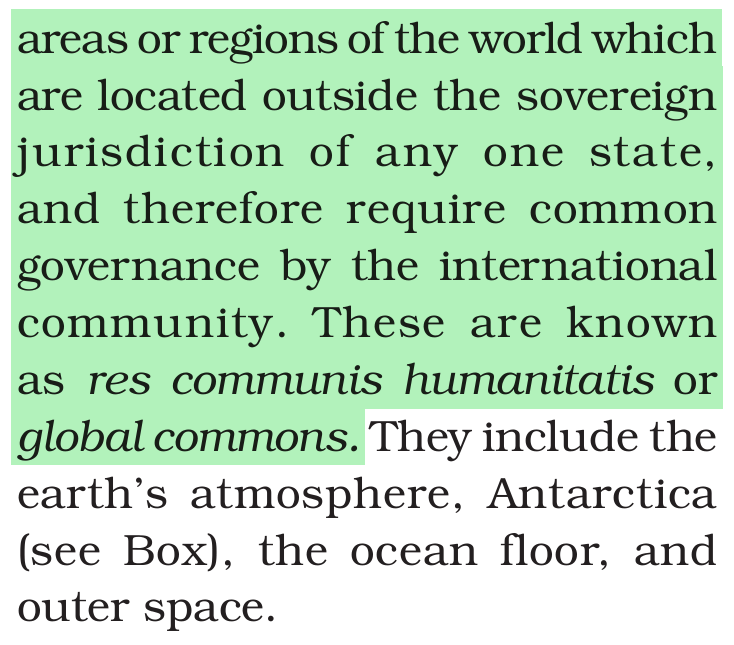
The correct answer is Option (4) → Areas which are located outside the sovereign jurisdiction of any one state and requires common governance by international community.
Option (1) Consensus on combining economic growth with ecological responsibility. Incorrect. This was the consensus reached at the Rio Summit, and this approach to development is commonly known as ‘sustainable development’.
Option (2) Relationship between economic development and environmental management. Incorrect. This was the concern of the Southern states at the Rio Summit, while the rich Northern states were concerned with ozone depletion and global warming.
Option (3) Adoption of innovative and potentially far-reaching ways to control the use of resources in 26 percent of the world’s wilderness area. Incorrect. This joins two lines about Antarctica: it comprises 26 per cent of the world’s wilderness area, and the claims over it have not prevented the adoption of innovative and potentially far-reaching rules to protect its environment.
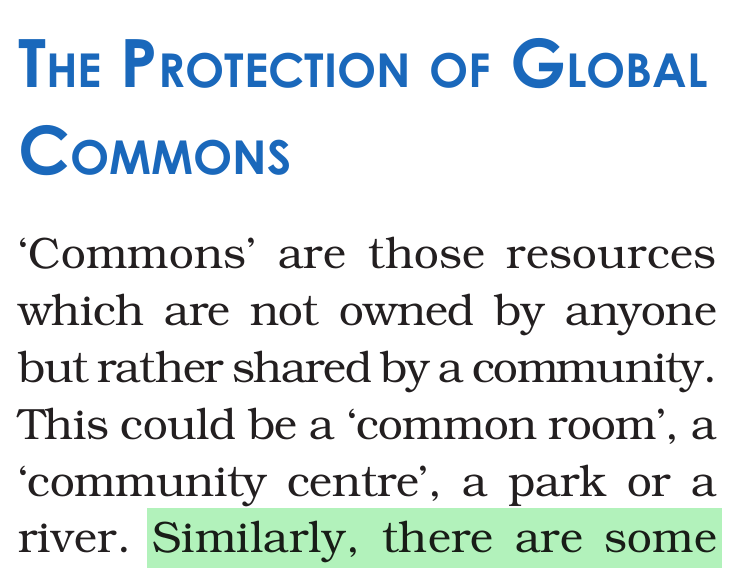
Option (4) Areas which are located outside the sovereign jurisdiction of any one state and requires common governance by international community. Correct. ‘Commons’ are resources not owned by anyone but shared by a community. Areas of the world that are located outside the sovereign jurisdiction of any one state, and therefore require common governance by the international community, are known as res communis humanitatis or global commons: the earth’s atmosphere, Antarctica, the ocean floor and outer space.
NCERT (2026-27): Contemporary World Politics — Chapter 6: Environment and Natural Resources
|