
Read the passage carefully and answer the Questions.
Ethers with the general formula $C_nH_{2n+2}O$ and functional group C-O-C may be divided as symmetrical and unsymmetrical. Lower symmetrical ether may be obtained by the dehydration of alcohols at low temeratures in the presence of protic acids, such as $H_2SO_4$ and $H_3PO_4$ wheras at high temperature intramolecular dehydration takes place. Formation of ether from primary alcohols is also accompanied by the formation of small amount of alkenes. Due to the stearic hinderance, secondary and tertiary alcohols undergo elimination reaction rather than substitution reaction yielding alkene as major product. Ethers can also be obtained by heating alkyl halides with sodium or potassium alkoxides. Substituted Ethers (secondary & tertiary) can also be prepared using this method. If primary halides are replaced with secondary and tertiary halides, alkenes are the major products.
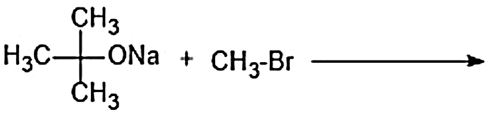
Major product in the following reaction is
Answer & explanation
Correct answer: option 4
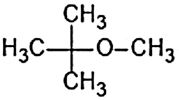
The correct answer is Option (4) →
The reactant shown is tert-butoxide sodium $(CH_3)_3C-ONa$ reacting with methyl bromide $(CH_3Br)$.
This reaction follows Williamson ether synthesis, where:
- Alkoxide ion ($RO^-$) acts as a nucleophile.
- It attacks a primary alkyl halide through $S_N2$ substitution to form an ether.
Reaction
$(CH_3)_3C-ONa + CH_3Br \rightarrow (CH_3)_3C-O-CH_3 + NaBr$
Reasoning
- $CH_3Br$ is a methyl halide, so $S_N2$ reaction occurs easily.
- Elimination cannot occur because methyl halides cannot form alkenes.
- Therefore, ether formation is the major product.
Product
$(CH_3)_3C-O-CH_3$
This compound is tert-butyl methyl ether (MTBE).
Correct option: the structure $(CH_3)_3C-O-CH_3$ (option 4).