Which of the following statements about selection tests are correct?
(A) An employment test may be a paper and pencil test or an exercise.
(B) Personality tests are easy to design and implement.
(C) Aptitude tests are good indices of a person’s future success score.
(D) A trade test measures a person’s potential to acquire new skills.
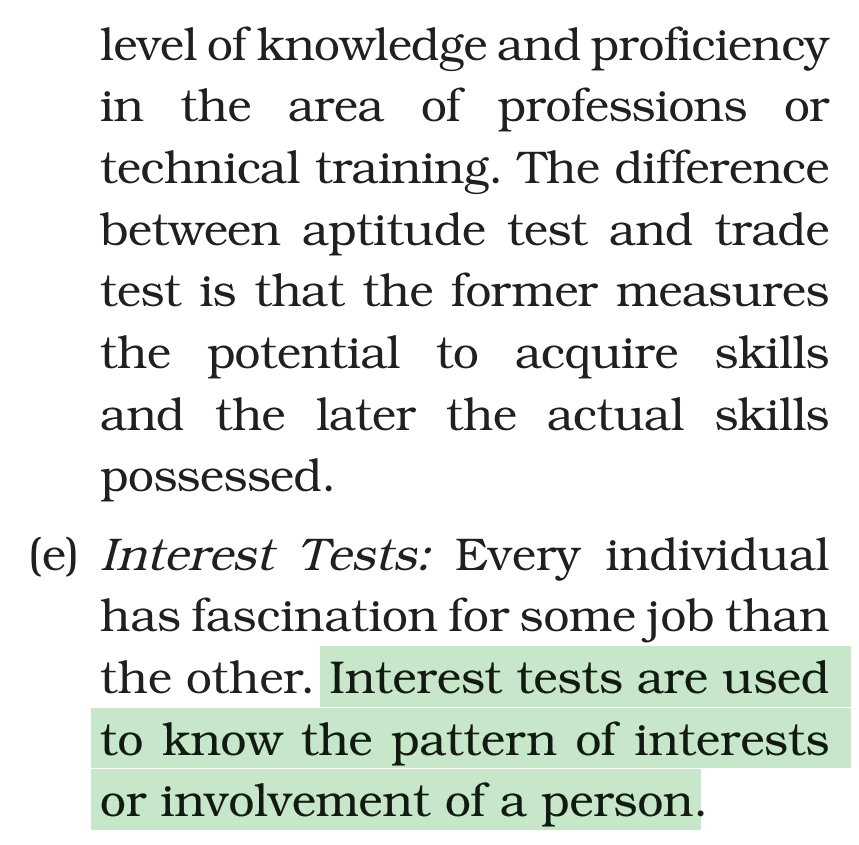
(E) Interest tests are used to know the pattern of involvement of a person.
Choose the correct answer from the options given below:
Answer & explanation
Correct answer: option 3
The correct answer is Option (3) → (A), (C) and (E) only
(A) An employment test may be a paper and pencil test or an exercise. — Correct. A test can be written, or a task to perform.
(B) Personality tests are easy to design and implement. — Incorrect. Personality tests probe the whole personality, so they are difficult to design and implement.
(C) Aptitude tests are good indices of a person’s future success score. — Correct. It measures the potential to learn new skills, so it points to future success.
(D) A trade test measures a person’s potential to acquire new skills. — Incorrect. A trade test measures the existing skills of a person. The potential to acquire skills is measured by the aptitude test.
(E) Interest tests are used to know the pattern of involvement of a person. — Correct. An interest test shows the pattern of a person’s interests or involvement in jobs.
NCERT (2026-27 Edition): “(ii) Selection Tests: An employment test is a mechanism (either a paper and pencil test or an exercise) that attempts to measure certain characteristics of individuals. These characteristics range from aptitudes, such as manual dexterity, to intelligence to personality.” “(b) Aptitude Test: … Such tests are good indices of a person’s future success score.” “(c) Personality Tests: Personality tests provide clues to a person’s emotions, her reactions, maturity and value system etc. These tests probe the overall personality. Hence, these are difficult to design and implement.” “(d) Trade Test: These tests measure the existing skills of the individual. …”
|