The constant ‘k’ in a rate law expression of a reaction is
Answer & explanation
Correct answer: option 3
The correct answer is Option (3) → dependent on temperature.
For a reaction aA + bB → products, the rate law is written as
\( \displaystyle \text{Rate}=k\,[A]^{x}[B]^{y} \)
Here k is the rate constant. If [A] = [B] = 1 mol L−1, then Rate = k, so k is the rate of the reaction at unit concentration of the reactants. It is also called the specific reaction rate.
Changing the concentration changes the rate but not k. What does change k is the temperature, as shown by the Arrhenius equation:
\( \displaystyle k=A\,e^{-E_a/RT} \)
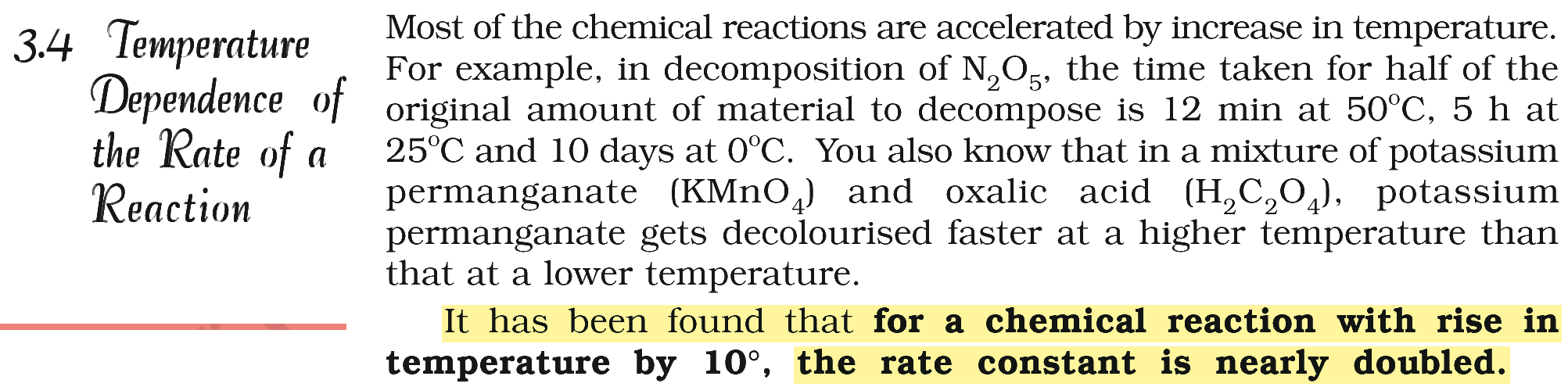
A higher temperature gives a larger k; for many reactions k nearly doubles for a 10 K rise. So the rate constant is dependent on temperature.
Why the other options are incorrect
Option (1) is dependent on the concentration of reactants — Incorrect. The rate depends on concentration, but k is the same at every concentration for a given temperature.
Option (2) is dimensionless — Incorrect. k always has a unit containing time−1; its full unit, (mol L−1)1−n s−1, depends on the order n.
Option (4) called the Arrhenius constant — Incorrect. In the Arrhenius equation, A is the pre-exponential (frequency) factor; k itself is the rate constant.
NCERT (2026-27 edition):
Temperature Dependence of the Rate of a Reaction