
Read the given passage and answer the following questions:
Spermatogenesis results in the formation of sperms that are transported by the male sex accessory ducts. A normal human sperm is composed of a head, neck, a middle piece and tail. The process of formation of mature female gametes is called oogenesis. The reproductive cycle of female primates is called menstrual cycle. Menstrual cycle starts only after attaining sexual maturation (puberty). During ovulation only one ovum is released per menstrual cycle. The cyclical changes in the ovary and the uterus during menstrual cycle are induced by changes in the levels of pituitary and ovarian hormones. After coitus, sperms are transported to the ampulla, where the sperm fertilises the ovum leading to formation of a diploid zygote. The presence of X or Y chromosome in the sperm determines the sex of the embryo. The zygote undergoes repeated mitotic division to form a blastocyst, which is implanted in the uterus resulting in pregnancy. After nine months of pregnancy, the fully developed foetus is ready for delivery. The process of childbirth is called parturition which is induced by a complex neuroendocrine mechanism involving cortisol, estrogens and oxytocin. Mammary glands differentiate during pregnancy and secrete milk after child-birth. The new-born baby is fed milk by the mother (lactation) during the initial few months of growth.
Which part of a human sperm possesses numerous mitochondria that produce energy for the movement of the tail?
Answer & explanation
Correct answer: option 3
The correct answer is Option (3) → Middle piece
A human sperm has four parts: a head, a neck, a middle piece and a tail. Each part has its own job. Sperms must swim a long way to reach the ovum, and swimming needs energy. The middle piece holds many mitochondria, the energy-producing organelles of the cell. The energy they make moves the tail, and this gives the sperm the motility needed for fertilisation.
Option (1) Head — Incorrect. The head holds the haploid nucleus with the chromosomes. Its front part is covered by the acrosome. The head carries the genetic material, not the mitochondria.
Option (2) Neck — Incorrect. The neck is the short part that joins the head to the middle piece. It is not where the mitochondria are packed.
Option (4) Acrosome — Incorrect. The acrosome is a cap-like structure over the front of the nucleus. It is filled with enzymes that help the sperm fertilise the ovum.
NCERT Extract:
Gametogenesis – “… The sperm head contains an elongated haploid nucleus, the anterior portion of which is covered by a cap-like structure, acrosome. The acrosome is filled with enzymes that help fertilisation of the ovum. The middle piece possesses numerous mitochondria, which produce energy for the movement of tail that facilitate sperm motility essential for fertilisation.”
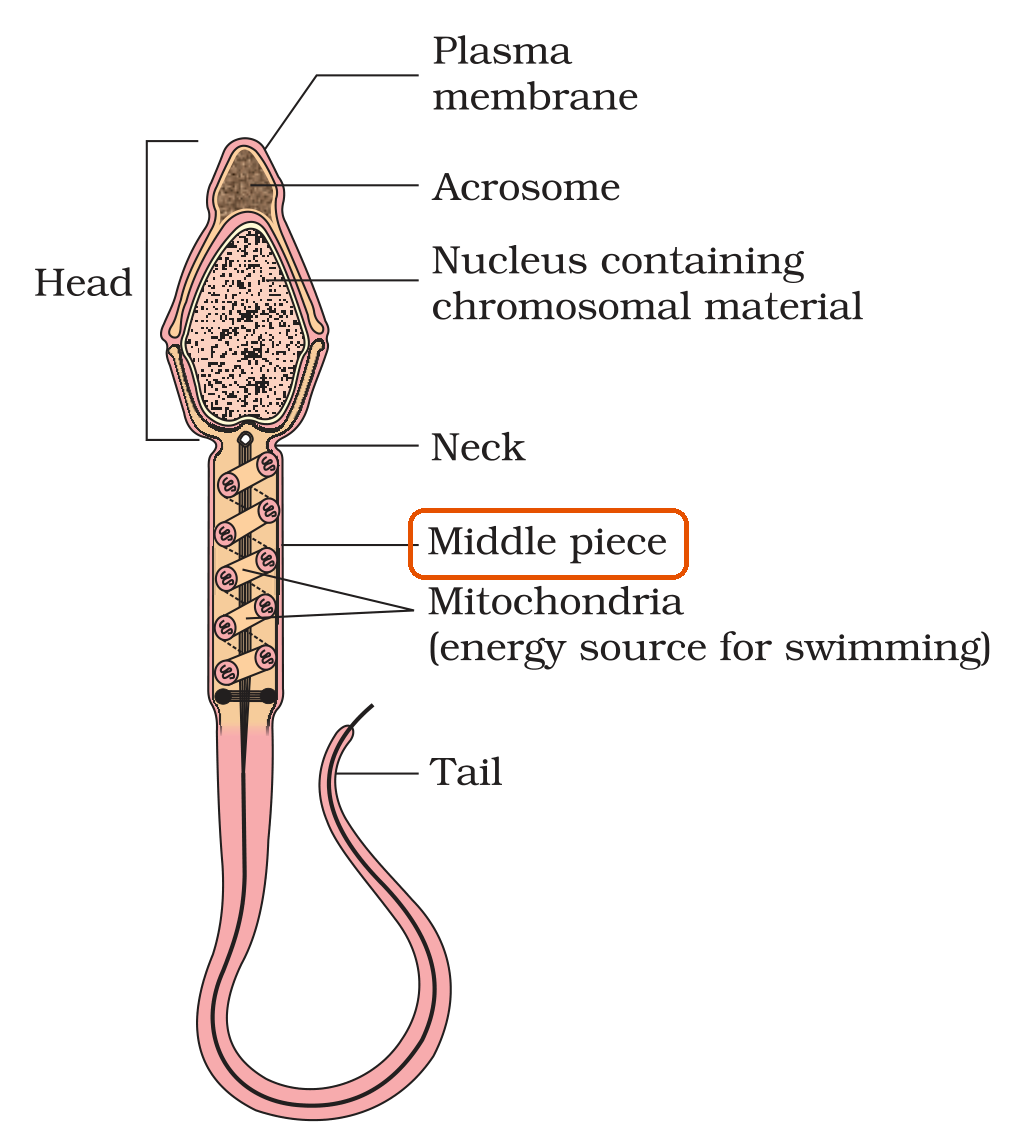
Figure 2.6 Structure of a sperm