
The figure shows the two enantiomers of glyceraldehyde.
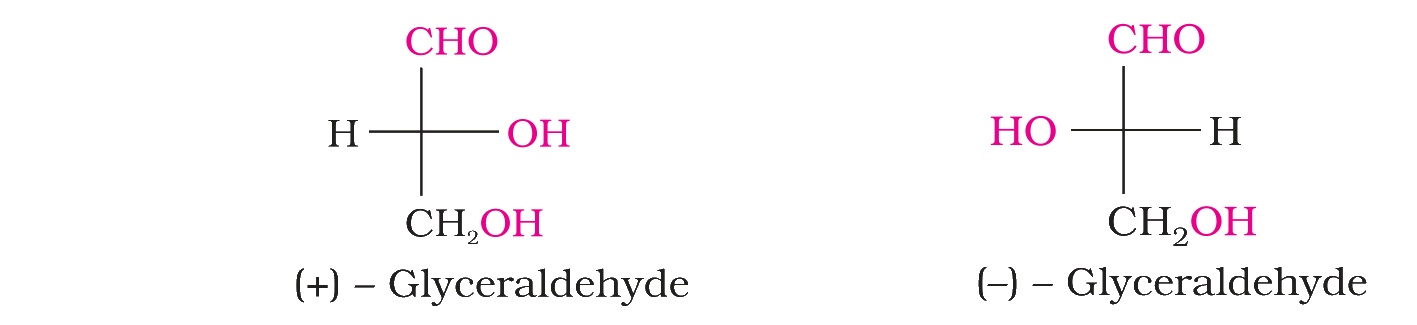
Which configuration is assigned to (+)-glyceraldehyde, and on which side of its structure does the –OH group lie?
Answer & explanation
Correct answer: option 4
The correct answer is Option (4) → D configuration; –OH on the right
The letters D and L give the configuration of a compound relative to glyceraldehyde. The structures are written with the most oxidised carbon (–CHO) at the top.
Side of the –OH group — right. In (+)-glyceraldehyde the asymmetric carbon has H on the left and –OH on the right; in (−)-glyceraldehyde the –OH is on the left.
Configuration — D. The (+) isomer of glyceraldehyde, with –OH on the right, has the D configuration; the (−) isomer, with –OH on the left, has the L configuration.
Why the other options are incorrect
Option (1) L configuration; –OH on the left — Incorrect. This describes (−)-glyceraldehyde, the second structure.
Option (2) L configuration; –OH on the right — Incorrect. The side is right, but –OH on the right means the D configuration, not L.
Option (3) D configuration; –OH on the left — Incorrect. The letter is right, but in (+)-glyceraldehyde the –OH lies on the right; –OH on the left goes with L.
NCERT (2026-27 edition):
10.1.2.1 Glucose – “(+) Isomer of glyceraldehyde has ‘D’ configuration. It means that when its structural formula is written on paper following specific conventions which you will study in higher classes, the –OH group lies on right hand side in the structure. All those compounds which can be chemically correlated to D (+) isomer of glyceraldehyde are said to have D- configuration whereas those which can be correlated to ‘L’ (–) isomer of glyceraldehyde are said to have L—configuration. In L (–) isomer –OH group is on left hand side as you can see in the structure.”
(+)-Glyceraldehyde and (−)-Glyceraldehyde