
Electrochemical Cell
A galvanic cell is an electrochemical cell that converts chemical energy of a spontaneous redox reaction into electrical energy. It consists of two half cells, the half cell in which oxidation takes place is called as anode and the other half cell where reduction takes place is called as cathode. Anode has negative potential with respect to the solution whereas cathode has positive potential with respect to the solution. As soon as the switch is in the on position, the electrons flow from the negative electrode to positive electrode and the direction of current flow is opposite to that of electron flow. The potential difference between two electrodes is called cell potential and is measured in volts. When no current is drawn from the cell, then cell potential is termed as cell electromotive force. The cell potential is given by Nernst equation.
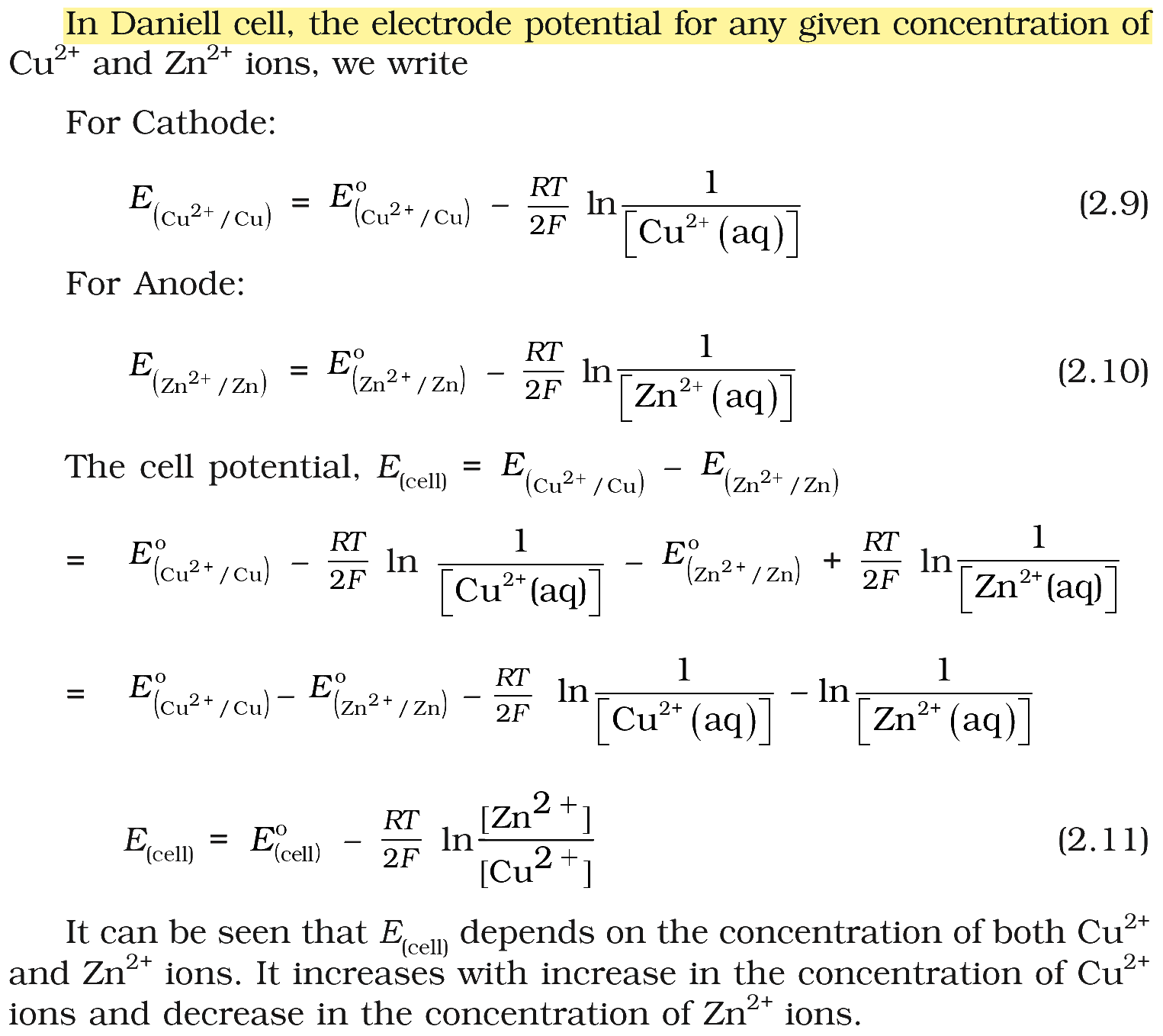
The Nernst equation for the Daniell cell can be written as
Answer & explanation
Correct answer: option 4
The correct answer is Option (4) → \( \displaystyle E_{\mathrm{cell}}=E^{\circ}_{\mathrm{cell}}-\frac{RT}{2F}\ln\frac{[\ce{Zn^2+}]}{[\ce{Cu^2+}]} \)
The Nernst equation for a cell reaction is written with the number of electrons transferred (n) and the reaction quotient, in which products appear in the numerator and reactants in the denominator. Pure solids have unit activity and are left out:
\( \displaystyle E_{cell}=E^{o}_{cell}-\frac{RT}{nF}\ln\frac{[\text{products}]}{[\text{reactants}]} \)
For the Daniell cell, Zn(s) + Cu2+(aq) → Zn2+(aq) + Cu(s), n = 2, with \( \ce{Zn^{2+}} \) the product ion and \( \ce{Cu^{2+}} \) the reactant ion:
\( \displaystyle E_{cell}=E^{o}_{cell}-\frac{RT}{2F}\ln\frac{[\ce{Zn^2+}]}{[\ce{Cu^2+}]} \)
Shortcut: Two electrons are transferred, so the term must be RT/2F, which rules out Option (1). The product ion \( \ce{Zn^{2+}} \) goes in the numerator, which leaves Options (3) and (4), and the term is subtracted, which gives Option (4).
Why the other options are incorrect
Option (1) — Incorrect. It uses n = 1 (RT/F) instead of n = 2. Adding the term with the ratio inverted is the same as subtracting it with [Zn2+]/[Cu2+], so the only error is in n.
Option (2) — Incorrect. It uses n = 2, but the ratio is inverted, with the reactant ion \( \ce{Cu^{2+}} \) in the numerator.
Option (3) — Incorrect. The ratio is correct, but the term is added instead of subtracted.
NCERT (2026-27 edition):
Nernst Equation – …
Note: The same/similar question has been asked in different years by NTA as per the details given below:
| 2026 | 2025 | 2024 | 2023 | 2022 |
|---|---|---|---|---|
| 30-05 S1 26-05 S1 | – | – | – | – |