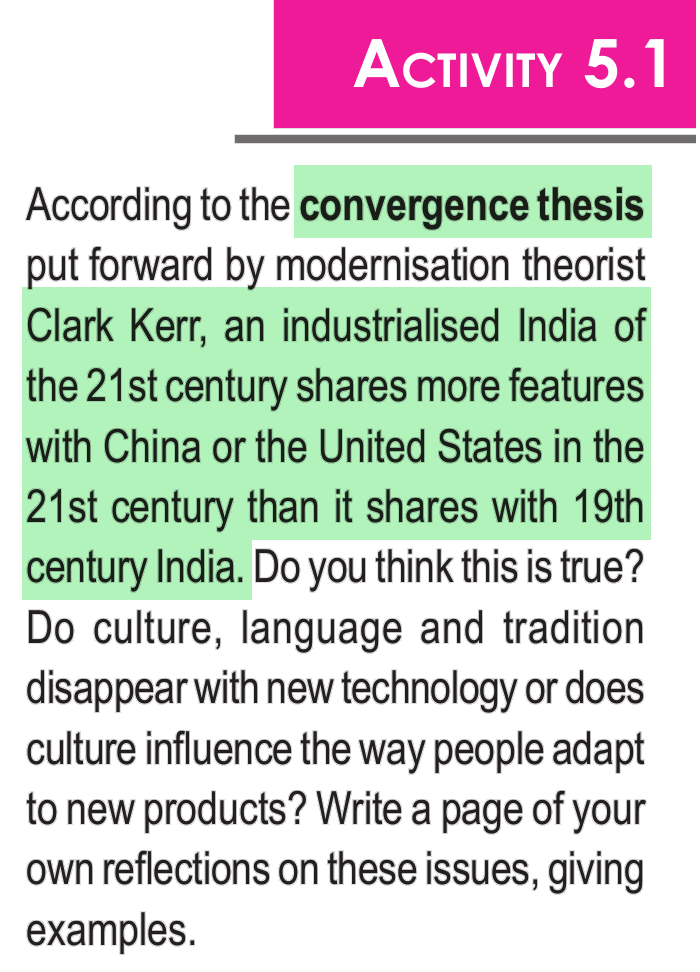
An industrialised India of the 21st century shares more features with China or the United States in 21st century than it shares with 19th century India. This can be understood as an example of which of the following?
Answer & explanation
Correct answer: option 2
The correct answer is Option (2) → Convergence thesis
Option (1) Resource mobilisation theory — Incorrect. McCarthy and Zald’s resource mobilisation theory explains social movements: a movement’s success depends on its ability to mobilise resources such as leadership, organisational capacity and communication facilities. It says nothing about industrial societies growing alike.
Option (2) Convergence thesis — Correct. The modernisation theorist Clark Kerr argued that industrialisation makes societies converge: industry brings the same kind of technology, work and organisation everywhere, so industrial societies grow alike whatever their past. That is why a 21st-century industrial India is said to share more with China or the USA than with its own 19th-century self.
Option (3) Modernisation — Incorrect. Modernisation is the broad process by which universal commitments, science and chosen identities replace local ties and ascribed ones. Kerr was a modernisation theorist, but the particular claim that industrial societies come to resemble one another has its own name, the convergence thesis.
Option (4) Secularisation — Incorrect. In the modern west, secularisation has usually meant a process of decline in the influence of religion. The question is about industrial societies sharing features, not about religion.
Note: The section ‘Theories of Social Movements’ of the chapter ‘Social Movements’, with the theory of relative deprivation, Olson’s logic of collective action and the resource mobilisation theory of Option (1), was there in the pre-rationalised NCERT, which NTA followed in 2023. This section has been deleted from the NCERT book (2025-26), though the chapter is still there.
NCERT: Social Change and Development in India — Chapter 5: Change and Development in Industrial Society (2025-26)
|